2/21/2006

What A Bitch! [FEBRUARY 19, 2006]

Well, it’s been a tough one and a half weeks – challenging at times, funny at others – but I think it’s finally over. Our faithful steed and loyal household companion, a.k.a. our blind Labrador Retriever named Ema, is no longer in heat. I can now walk comfortably through the winding streets of Cádiz and loosely hold the leash in my relaxed fingers. She no longer sniffs every puddle of urine and damn street corner or curb, but walks with her head held proudly and elegantly as she once did. She even obeys orders again and doesn’t go running into the middle of the street towards the slightest sound resembling a whimper, bark or growl. One look and you can tell... She’s not that horny anymore. But it wasn’t always like this. No sir!


"Hey there, sailor. Lookin' for a good time?"

For those of you that don’t know, I’m a relatively new dog owner. In fact, I would say I was forced into it as my girlfriend flew in Ema from her native Czech Republic with little or no say on my part. I would have rather seen the mangy mutt dead before living with it but, over the course of a few weeks, I became attached to her. In fact, I eventually began looking forward to her emphatic tail-wagging-greetings at the door upon coming home and our nice little strolls on the beach every morning and evening. A few months after that dreaded four-legged carpet first entered my life, I dare say I couldn’t ponder living without her. So, one can imagine my surprise and anxiety when, about two weeks ago, I saw a tiny puddle of blood under where Ema had been sitting. I was worried and picked her up by the tail for a quick inspection when I saw it and called over my girlfriend, "Come quick! There’s something wrong with Ema! Her asshole is bleeding!" But it wasn’t her asshole. It was her vagina and I was warned... she would soon be in heat.


Me, the unexperienced dog owner, a few months ago
unsure of what to do at the sight of other mutts

I’m assuming most people are like me and, as I was prior to this experience, have no idea what exactly is going on when a bitch is in heat. Well, here’s a quick biology lesson. The canine menstrual cycle isn’t like the human one. In fact, bitches only menstruate twice a year for about two weeks and, unlike women, can only get pregnant during this period. During the rest of the year, when they aren’t menstruating, they don’t even think about sex and don’t have to worry about those drops of blood dripping down their hind legs every few minutes. My girlfriend swears it would be perfect if the human female reproductive system worked like that of a dog... No concerns about forgetting to take the pill and getting pregnant all the time; No changing tampons or panty-liners in public lavatories for a week out of every month (and worrying about whether you brought one with you when you go out for the evening); And, best of all, the dreaded PMS would only strike twice a year. I, for one and as a male, would NEVER want it to work that way. It would mean having sex only twice a year and I sometimes need it twice a day! Although, come to think of it and from what I’ve been told, by the time we’ve been together for over a decade, having sex once every six months sounds like the right kind of frequency. Hell, I’ve heard of married men who are lucky to get even that.


"DAMN! I smell me some booty... Is that bitch in heat?"

But getting back to our blind blonde, Ema, she was nothing but one headache after another for those two weeks. First of all and most basically, she would leave blood everywhere. It really started getting on my nerves after the first few days and I even suggested tying a diaper around her hind quarters. My girlfriend said it was a bad idea. She had already tried it once in Prague when Ema was in heat a few years ago. When they went for a walk early one morning all those winters ago and my girlfriend, in her half-awake stupor, forgot to take the diaper off, the dog ended up first pissing and then shitting herself. I’m inclined to think it wasn’t a pretty sight.
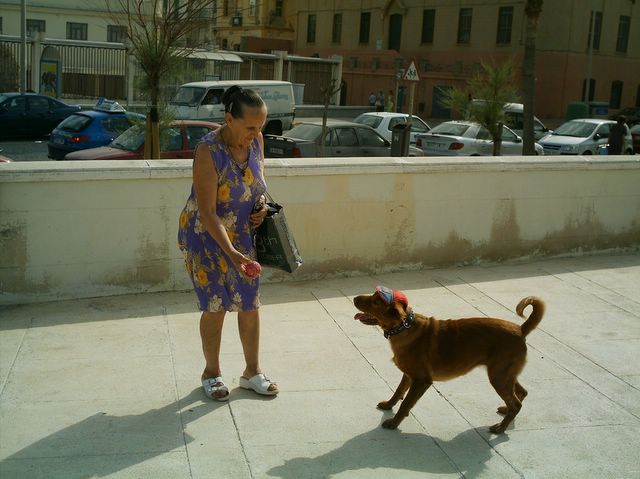

Well, how can he wear a ball cap if he doesn't have a ball?


Now that's better!

So, we ended up mopping the blood after Ema every few hours or so. But that wasn’t the most distressing of our worries. The real challenge came when we took her for her obligatory two walks a day. Every time a dog approached, she would prepare for sex by curving her tail to the extreme left or right and leaving it there – allowing for "easy access" as my girlfriend has dubbed it. I thought it wouldn’t be that much of a problem seeing as Ema is blind and can’t actually see any other dogs. But that didn’t stop her. At the mere sound of another mutt, or whiff of what might be a mutt, or even when there wasn’t a mutt around but she thought there might be, our blind fur-ball would just stop there in the middle of the street, curve that tail, and wait patiently for penetration. A strong yank on the leash or a smack on the head was the lone thing that would get her moving again... only so that she could repeat the whole damn thing a minute or so later.


"Hey buddy, forget the old lady. Do you see that bitch? She's curving her tail at me!"

Ema, though, wasn’t the worst part of this daily ritual. In general, she’s very well behaved and trained. Only when it comes to sex does she get all worked up and in a frenzy. As for other dogs – the true mutts of Cádiz – they’re not trained at all and you can imagine how they act when it comes to sex. The male dogs were all over Ema during the daily walks. They’d sniff her hole and follow her half way through the city, ignoring my threats and adamant foot stomping. Where were the owners, you ask? Who knows! The only "responsible" dog-owners you see here in Cádiz, well at least those of them that are old ladies, and don’t let their pets roam free are so lazy to walk their dogs, that they reluctantly do it in their bathrobe and slippers. It’s quite a sight seeing old ladies wander the streets in their comfortable domestic eveningwear and being led by lap-dogs! As for the rest of the locals, the irresponsible ones, they’re probably drinking their coffee somewhere or having an early tapas at the local bar while their mangy mutts roamed free. And mutts is what most of the dogs here in Cádiz are.


Documented Proof: The lady on the left is wearing a blue bathrobe
and slippers in the town center in the middle of the afternoon

I know I call Ema a mutt, but she is actually a pure-bred Labrador with a pedigree. I have only seen a handful of purebreds here in Cádiz. In fact, even the central pet-shop near the fish market only sells cross-breed mutts, and at practically the same price of what you can get a pedigree pure-bred in Prague. Don’t get me wrong, a lot of them are really cute and adorable and their owners still love them, or even dress them up, as they would an adoring child... Even though most of them are strange cross-breeds with protruding jaws or short-haired bodies with long-haired tails or slobbering mouths that their stubby legs can hardly keep up with. The biggest setback, though, must be that they are impossible to train. And even if they weren’t, the Spanish around here don’t seem to mind. They just let them run around town without a leash or even a collar, and leave the dirty work – of keeping those mongrel phalli away from Ema’s purebred love-cavern – to me.


"Hey, bub. Who you callin' a mutt? My name's Sir Winston."


Sorry about that Sir Winston. These guys are the mutts I was talking about...


...And this litte bastard with an underbite made my life
a living hell each time I stepped foot outside the door

Ema must have realized after about halfway through her cycle that she wasn’t going to get any doggy-lovin’ on our watch. That’s when she resorted to desperate measures. At first, she only did it to my girlfriend... As my lovely Czech sat there on the sofa watching TV with her legs crossed, Ema would slowly sneak up and mount by grabbing onto her knee and commencing the infamous doggy-style. I had a good laugh, "Silly mutt! Only male dogs have sex like that!" until she started doing it to me a few days later. In fact, she even mounted a few visitors we had invited over our place during the weekend. No one was safe while Ema was in heat and if she couldn’t get a male from her own species, then a human leg, regardless of gender, would do just fine thank you very much.


Ema under a severe sniff- and lick- blitzkrieg... and enjoying every minute of it

As I initially stated, thank God though that all of this has finally come to an end. Nowadays, we can walk our lovely Labrador on the beach once again without the fear of having her followed by a pack of male dogs frothing at the mouth over the irresistible odor emanating from her nether-regions. She currently prefers, as she once did, chasing balls and eating salami scraps off the pavement to dry-humping the legs of our house guests. Even the local mutts, which used to follow her without reprieve, now give her and me some breathing space... although they occasionally do sneak by and get a well-sought-after sniff or lick. But, most importantly, no matter how much they lick or sniff, that tail doesn’t get into the "easy-access" position anymore. Now, when I tell Ema to sit, she sits. Lie down and she lies. Stay and she stays. She is once again as loyal and obedient as she ever was. Now that I think about it, it’s amazing what will happen to a living creature when sex is involved. It’s a basic instinct and all creatures, from a bird to mankind, would do whatever it takes to get a few precious moments of pleasure. The one thing I don’t understand about dogs, though, is why do they need it so much when they’re in heat if they can just lick their own genitalia? Hell, if I could pull that one off, I would never leave home. In fact, I doubt I would have ever been able to finish typing up this article...

2/15/2006

¡Que Aproveche! [FEBRUARY 12, 2006]

One of the most important things about going to another country and experiencing its culture is having an open mind. It’s a different place and, seeing as you’re only going to be there temporarily, you should try to absorb as much of the local atmosphere as possible. This is especially true when it comes to food. There’s nothing I hate more than seeing a group of Americans here in Spain, who are probably on vacation for less than a week, standing in line to order a Whopper from Burger King. Now I know Whoppers taste delicious – especially with a slice of cheddar cheese and some bacon – but don’t you get enough of that crap at home? You’re in another country for God’s sake... give the local flavor a try.

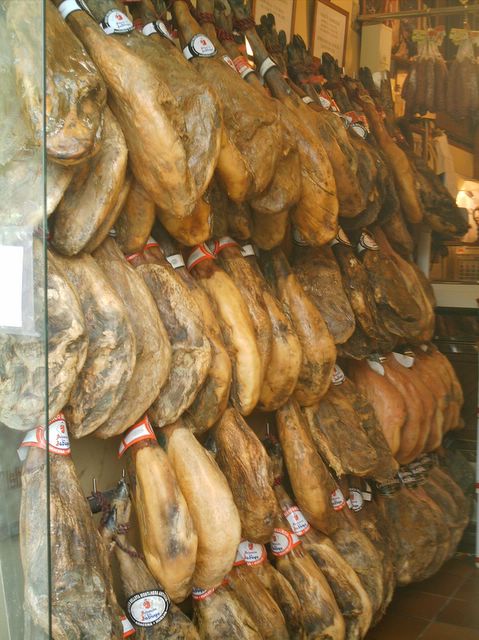
The two most typical Spanish dishes, ones that are known the world over, are paella and jamón serrano. Actually, paella is the only real dish (rice in a saffron-base with fish and game meat). Jamón is just a leg of cured ham – but it is DAMN good. Now, as a foreigner in Spain, you probably won’t want to try the jamón. I know I didn’t when I first came here. It can appear a bit intimidating under initial impressions seeing as it looks like, well, a leg of ham. And I’m not talking about that butterball processed crap we have back home and call ham. No sir. This one comes in the form of an actual pig’s leg, hoof and all, and dangles from the ceiling for everyone to see. When you first walk by your typical Spanish bar and see those dozens of legs (or even hundreds as I once witnessed in Madrid’s aptly named eatery, El Museo de Jamón) hanging there like something out of Hannibal Lecter’s twisted fantasy, don’t be turned off! Enter bravely, tell the barman to grab that hoof so he can cut you up a few slices and – seeing as they probably won’t have any fava beans or Chianti – get yourself a side dish of olives and a nice glass of Sherry to top it off.


Who needs interior design when you have pigs' legs?


Spain is the only country where you can actually see a hoof among
your neighbor's garbage and not worry if he's into Voodoo

When one thinks of jamón and the way it just hangs there with its hoof, you realize the Spanish don’t have this aversion most of us in the States do to eating food that might resemble something that was once alive. Think about it... When was the last time you went to the supermarket and saw a hoof, head, or hide? We get all that stuff chopped off and what remains is either vacuum-sealed or flash-frozen. The end result is that we take home chicken breasts, legs, or even processed nuggets, but never an actual chicken. I know what you’re thinking, "I just got a whole chicken the other day and roasted it in the oven, you dumb bastard GC." But here in Spain, it’s not considered to be a whole chicken unless it’s actually WHOLE. That’s right folks. They sell the chickens here with the head still attached. In fact, there are even a few feathers sticking out every now and then too. Imagine my surprise when I first bought a chicken at the local supermarket, came home, unwrapped the plastic and lifted it from its styrofoam tray only to find those beady little eyes staring back at me and that wattled beak drooping lifelessly. I just couldn’t get it. What’s the point of selling a chicken with the head still attached? Who eats chicken heads? What possible use can they serve? None, I thought, until my girlfriend asked one of her young students what her favorite food was. The twelve year old Spanish girl responded without hesitation, "Chicken Blood!"


Chicken heads: A rare sight for the non-Voodoo practicing American consumer

Barn yard animals aside, one finds the most variety in Spanish cuisine when it comes to seafood. Statistically, the Spanish are the second largest consumers of fish and seafood in the world. Only the Japanese outrank them. This appetite for anything from the salty sea is insatiable. Even in Madrid, the capital and largest city but geographically the furthest point from the sea on the Iberian Peninsula (it takes about 8 hours, for example, to drive there from Cádiz), this never-ending demand for seafood can only be satisfied by having it flown in at all hours of the day. Wherever you maybe in Spain – from the mountain tops to the desert valleys – you can always find a fresh plate of fish.


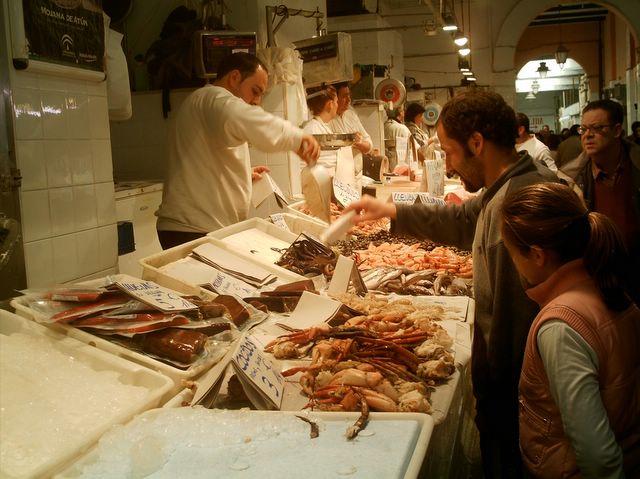
The local fish market is always one of the most popular places in town

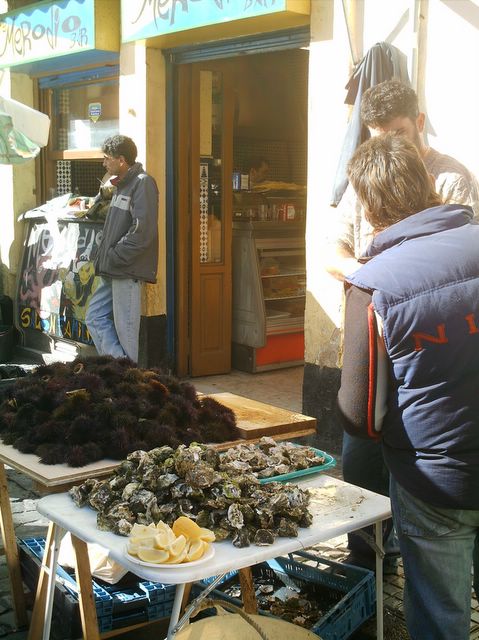
Here in Cádiz though, we’re lucky. We don’t need to have anything flown in. The sea is everywhere. You can’t turn a street corner in this town without seeing a fish restaurant or fish for sale in same shape or form. But the fish isn’t the strange thing. I love eating fish and view it as one of the best things to have ever happened to the art of cooking. My problem with the local flavor is their appetite for that really strange, non-fishy, other seafood. You see, I’m not talking about shrimp, crabs, or lobster. I’m referring to everything else that thrives in the murky depths of the Atlantic – octopus, cuttlefish, slugs, barnacles and sea urchins – and it’s tough to be open-minded when these grotesque critters are staring at you from the dinner plate. They love this stuff down here and most of the time even eat it raw. If the residents of Cádiz were to have a culinary motto, it would probably be, "If it comes from the sea, it’s good enough for me!"


The title on top of this poster found at a local
restaurant reads: "Seafood from the Bay of Cadiz"
Need I say more?

Now granted, it is strange to me that they eat all of this stuff, but like I said at the opening of this article, if you’re in a foreign country you should at least give the local flavor a try. I’ve tried the octopus... not bad. In fact, the pulpo a la Gallega way of preparing the tentacled beast is delicious. But that’s just the thing – they actually cook and prepare the octopus when they make it in that fashion. As for the barnacles and sea urchins, and many times even baby prawns, they serve them raw. In fact, they normally sell these things on the sides of busy streets and in one-serving containers just like we do with nuts and potato chips back home. You can always spot a few happy faces on Sunday walking through the marketplace or doing a bit of window shopping while they expertly munch away at the raw prawns or barnacles they just bought. The only hitch is that they are continuous lyon the look-out after what they’re eating – those baby prawns like being swallowed alive almost as much as they like being out of the sea and they make a jump for it any chance they get! And yes, before you ask, I have had an open mind and given these raw "delicacies" a try... trust me, stick to the Whopper with bacon and cheese on this one.


Anyone want some raw sea urchins, barnacles, or whatever the hell that other stuff is? Makes for a great snack!


Or maybe some baby prawns (cooked variety) are more to your liking?

But don’t write off all Spanish seafood just because their cuisine includes a sea creature that you know exists only from old pirate films and Mutiny on the Bounty ("Arghh! I’ll have ye scraping the barnacles off the hull, I will!"). Raw sea urchins and slugs aside, they actually do have some damn good seafood down here. If I had ignored it all because of the jumping baby prawns, I would have never discovered this fried seafood down here, either cazón en adobo (dogfish in spice) or chocos (cuttlefish tentacles), that makes my mouth water at just the mere thought of it. In fact, I would dare say these things have now entered my top ten list of favorite foods. I would have never thought that I’d like fried dogfish or cuttlefish so much but, like I said, you never know if you don’t try. So before you sidestep the entire issue of Spanish seafood, do yourself a favor and visit the local fish market (every town in Spain has one). It’s a Mecca of every underwater creatures imaginable – all waiting to be bought and prepared at home. Take a little stroll through, see what each fishmonger’s stall has to offer, and don’t be afraid to try. Who knows? You may find yourself adding Hermit Crab to your list of favorite foods one day!


"Daddy, why are you playing with your food?"
"I'm not. It's playing with me!"

And even if seafood isn’t your thing, remember that there’s always paella and jamón serrano. The main point though is to not overlook anything just because it looks strange. Who knows when you might be surprised. Be brave! Smile at your Spanish hosts, wish them "¡Que Aproveche!" ("Enjoy Your Meal!"), and dig into the feast they have set out before you. Take a bite out of that pig’s leg, munch on a handful of raw baby prawns, suck those sea slugs out of their shells, and wash the whole lot down with some thirst-quenching chicken blood. After you’ve done all that, had your fill of the local cuisine, and wished your gracious hosts good night, step out the door and head for the nearest Burger King where you can finally scarf down that delicious Whopper with bacon and cheese. Considering what your adventurous taste buds have just been through, they deserve a good ol’ burger...

2/06/2006

Aluminium, Fags & Rubbers [FEBRUARY 5, 2006]

Apparently, the a in "wash" and the a in "palms" are pronounced differently. I had no idea. I’ve been speaking English for twenty-seven years now and then something like this comes up and smacks me in the face. As it turns out, I haven’t been speaking English all along... I’ve been speaking American English.

My girlfriend first pointed it out the other day. I had just done a pronunciation lesson with my adult students in class and was telling her all about it, "The way these Spanish pronounce their English is really interesting! I was doing some phonetics drills and none of them could hear the difference between the vowel sounds in ‘He bought the law’ and those in ‘Wash your palms.’"
"Which difference? The one between bought / law and wash or the one between wash and palms?" she replied.
"What do you mean the difference between wash and palm? It’s the same sound... wAAAsh and pAAAlms...."
"No, no, no. It’s wAUsh and it’s pAAAlms. Trust me."
And so an argument ensued. We always get into arguments when it comes to English. She’s convinced she’s right, and I’m convinced that I’m right – especially since I’m the only native speaker in this relationship. But my Czech girlfriend insists it’s because she’s speaking proper British English and I’m spewing out gunslinger Yankee-talk. And this time, the argument was pretty bad – almost as bad as that time I was convinced there was no such word as "aluminium". There’s no i in "aluminum", damn it! Then she took out the dictionary and, low and behold, she was right. There WAS an i in aluminium!

She was right this time too. Palms has the same vowel sound as "arm" and "father" whereas wash has the same vowel sound as "hot" and "rock". She even had an Oxford University dictionary to prove it. Still not convinced? Well, if the vowels in palms, arm, father, wash, hot and rock all sound similar to you too, then you’re in the same boat as me. You must be a Yankee. But don’t worry! I did a little research of my own – just because I think those "linguists" up at Oxford are a bunch of stuck-up bastards – and went to have a look at good ol’ Merriam-Webster who, surprise surprise, listed all of those vowel sounds as being pronounced the same way. In the end, it turns out, North American speakers are simply unable to reproduce the a in "wash" and distinguish it from the a in "palms". British English has an extra sound we never even heard about. And just imagine, I needed a Czech to tell me about it!

But it’s not only pronunciation that poses a problem. There are differences in everything from grammar to spelling when it comes to which side of the Atlantic you’re on. Slang terms are the worst. I remember once when I was living in Madrid (this was when I used to smoke) and I had also recently learned that the British slang term for cigarette was "fag". Well, I was at a bar and saw that I had run out of cigarettes and went to a table of Brits sitting by the corner. I kindly asked, "Hey guys, can I bum a fag?" Little did I realize "to bum" means to sodomize someone in British slang. They were obviously aware of the American slang usage of "fag" when they replied, "I don’t know, mate. Depends on how you like it, dunnit?!" and had a good laugh at my expense. I never bummed a fag again.

Don’t worry though. I’ve mocked countless Brits in my day too. My girlfriend and I were watching an English detective series known as Midsomer Murders once. The detective was interviewing a sweet little old lady who was cooking and asked him, "May I tempt you to a sausage, Inspector?" "No thank you, ma’am," he replied. "Well then, what about a bit of Spotted Dick and Custard?" she insisted. Eventually the Inspector gave in and accepted. Spotted Dick and Custard?! What the hell is that? Nowadays, whenever I meet someone and I’m not sure whether they’re a Brit or not, the first thing I usually say is, "I got four words for you – ‘Spotted Dick and Custard.’" If they reply and tell me it sounds like some disease you get from a Thai whore, I know they’re not British. On the other hand, if they say it’s a delicious pudding, then I leave the subject be and snicker under my breath.

Granted, these minor discrepancies in different versions of the language don’t usually hamper communication between the two types of speakers. If anything, as in my case, they make for a good laugh every now and then. But when you make a living out of teaching the most popular language in the world, it’s nothing but a headache. I’ve had a number of advanced students question me about dubious statements made while standing in front of class. When I once stated that a student had "finished his test quicker" and also done better than the rest of the students, that very student asked me why I had said "..finished his test quicker" and not "...finished his test more quickly." Grammatically, I should have used an adverb and not an adjective but American English tends to opt for the adjective instead of the adverb. How many times has President Bush said, "Our troops are doing real good" instead of "really well" and no one makes fun of him for that little faux pas. It sounds natural to us... The "Department of Strategery", on the other hand, doesn’t. Come to think of it, I guess Bush isn’t the right kind of an example when it comes to proper grammatical usage, but he does make for a good showpiece in this instance.

On the flip side, it must be even more of a headache for students of the English language. How do they know which version to use? My girlfriend, for example, always used to tell me to put the dog on the lead when I took her for walks. After a few strange looks and a confused scratch on the noggin, she realized I had no idea what a lead was and started using leash. Now when she says it, I smile and thank her for reminding me. She also once asked me, "Shall we go for a walk?" and I asked her what the formality was all about. "Shall we do this or Shall we do that – Woe is me!" She got fed up with my mockery and, again, proved me wrong by pointing to her grammar books which indicated "Shall we..." is a perfectly normal way of indicating a suggestion in Britain. But screw the books and the Queen’s English. I still teach it and say it the way nearly 400 million people back on the other side of the Atlantic do. What’s wrong with "You wanna go for a walk?" It may not be proper, but at least no one will make fun of my student when he goes on holiday to the United States and hits on that hot girl he just met. He won’t say, "Oh dear, whatever shall we do once we have finished our drinks?" but rather, "Hey baby, wanna go back to my place and catch a ride on the love train?" She may slap him either way... but at least he’ll have done it in style.

The thing is, I’ve got a lot of work to do if I want little Carlos and Juan to grow up and be able to throw out that kind of American smooth-speak to the ladies. Nowadays, they start the kids off young here in these language schools. The newest generation have all been learning English since they were five or even four years old. Don’t get me wrong – that’s great. The younger the student, the better his or her aptitude for learning a new language. The only problem is that they’ve started them off on British English so I have a lot of damage to undo. My first day of class, for example, one of the kids asked me if I had a "rubber" on me and winked. I almost sent him to the principal – with a mouth on him like that – until, that is, I realized that a "rubber" is actually an "eraser" in the UK. I told him to use "eraser" with me and none of the students have said "rubber" ever since. But hey, they’re kids. They adapt easily and listen with awe to whatever the teacher says. Not only do none of them say "rubber" anymore, but they also use "pants" and "sneakers." Screw "trousers" and "trainers." By the time the school year is done, I’ll have them saying "cool" and "awesome" too.

The only problem with all of this re-education is that I won’t be able to teach my students – young and old alike – the different vocal sounds in the phrase "Wash your palms." But then again, does anyone really care? There are ways to work around it. Besides, I’m American and I’ll teach them the English I know... "Dude, clean your hands."

1/30/2006

"Don’t be one of those people who throw papers in the public street!" [JANUARY 29, 2006]

An American, a Czech and a Spaniard walk into a bar. They each order a coffee and, once the barman serves them, they each tear open the sugar packet that came with their drink and mix its contents in. The American crumples up the empty packet and leaves it on the counter. The Czech neatly folds it in half and places it between the cup and the saucer. The Spaniard just tosses it on the floor along with the spent cigarette dangling from his lips – despite the fact that there’s an ashtray directly in front of him. There’s no punch line to this joke, folks. Anyway you look at it, the Spanish are pigs.


"Yeah, that's my trash on the floor. You got a problem, amigo?"

Now I know that people litter no matter what country or corner of the globe you’re in. It’s a fact of life and one that people who respect the environment cringe at the sight of. In most industrialized nations, the government in conjunction with these deep-rooted environmentalists form some sort of campaign to stop the pollution of our planet. Such a simple thing, they tell the populace, as placing your empty gum wrapper in a bin instead of on the street can make a world of difference. Everyone is always on the lookout for a litterbug and people generally turn up their noses at the sight of one. At the end of the day, those who litter form the minority of an environmentally-conscious whole.

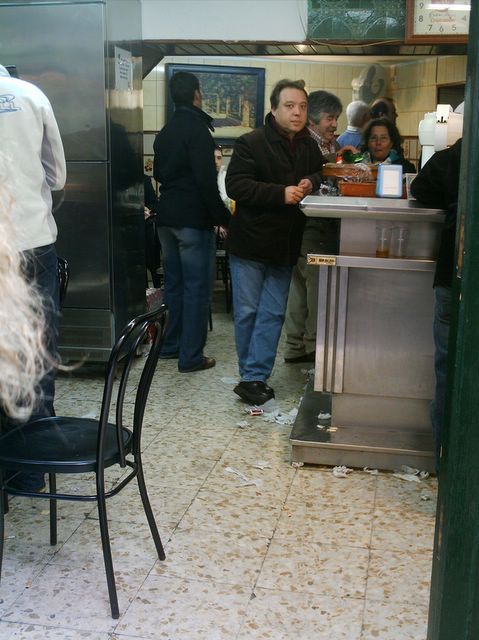
In Spain, however, the opposite seems to be true. Everyone litters. People toss papers, cans, bottles, bags, fruit skins, empty cigarette cartons, sandwich wrappers, warped umbrellas, toilet seats, fruit & vegetable crates, broken light bulbs, diapers and whatever else you can think of onto the street and into the sea. In the cafés, customers ignore ashtrays, tables, and counters and opt for the floor as their trash bin of choice. Stranger yet, the proprietor gladly sweeps up after them every few minutes because he views this kind of behavior as normal. I wouldn’t be surprised if that very café owner tosses his trash on the floor too when he visits other cafés. And on the streets, it’s even worse. Wherever one spots a group of Spaniards, there will always be a few pieces of litter left in their wake – sprinkled by the omnipresent shells of those sunflower seeds they so dearly love to eat.


Where the hell did all those umbrellas come from?


Just a regular park bench after a little snack... sunflower shells included

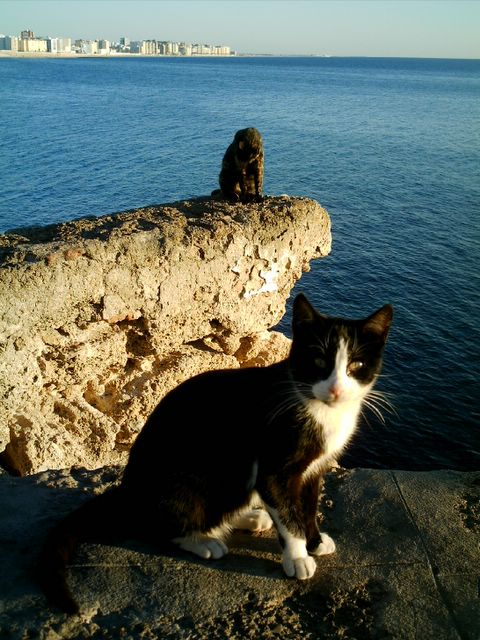
As far as I can tell, the Spanish must see it as their God-given right to litter. At any time of day, on whichever street corner of Cádiz you find yourself, you’re bound to find at least one piece of litter strewn on the cobblestoned pavement below. Even when you look over the city walls towards the sea – onto the massive boulders that protect the residents from the crashing waves of the mighty Atlantic – one can’t help but notice the piles of trash that haplessly have been tossed aside here. These boulders have now become a feeding ground for stray cats and seagulls as they scavenge the litter and pick at anything that might resemble a morsel of food. This type of behavior is even more difficult to understand when one considers that the sea has been this city’s lifeline since the day it was founded. Recently, in these times of rough unemployment, it has been one of the only reasons why tourists come to visit. A "day at the beach" must contribute hundreds of thousands of euros to the struggling local economy and yet, still, the Gaditanos view the Atlantic as nothing more than their local dump. If they can’t toss litter into the vast ocean, then where should they?


Ahh, Cádiz! Postcard picture perfect - just... ...DON'T LOOK DOWN!

The zenith of all this littering, though, occurs during public festivals or Carnaval, which is fast approaching at only a month away. The pre-Carnaval celebrations that have been going on over the past two weekends have been a sign of things to come – piles of trash scattered throughout the streets. As we were walking around this Sunday (Erizada, or Sea-Urchin Fest, was taking place in our neighborhood) we found it difficult to ignore how much litter had accumulated outside our door. I understand that oftentimes, especially during public celebrations, there may be no trash can or bin of any sort available for public use in the vicinity. But this isn’t the case in Cádiz. Before each Fest, the city sets up extra bins every few steps away for the revelers to use... but they simply ignore them. We saw countless piles of trash strewn on the ground while practically empty bins stood in their midst. I don’t understand. How difficult can it be to lift your arm and throw that bottle or used plastic plate into the empty bin by your side? We even saw a couple of people using the trash bin tops as tables to rest their food and drinks on or, even worse, they would simply pile their trash on top of the bin without bothering to open it– as if a plastic cover can be that heavy!


Spain's only Environmentalist:
"Where's the trash bin? Oh well, I'll just leave my dirty cups and plates on this plastic lid."


The littered remains of pre-Carnaval fun... ...And the empty trash bin next to it.

One of the most frightening things in all of this littering-mayhem is the attitude of Spaniards – even what must be environmentally-conscious Spaniards if they actually do exist – towards others who pollute. The locals really don’t give a damn at all. In fact, none of it seems strange in the least to them. Why walk to a bin, the local reasoning must go, when you can just as easily toss it on the ground? And this kind of conditioning to a lack of environmental awareness starts young and continues into adulthood. Not once have I seen a child reprimanded for dropping a candy wrapper, or an adult look at one of his fellow countrymen and shake his head in disgust as someone soils his beloved España.

I don’t want to try and rationalize this behavior and, frankly, I’m really not sure why the natives of this lovely land treat their country in such a manner, but I think it might be subconscious. They’ve been programmed to think this way. For example, as far as I know, there is no word in Spanish that litter can be directly translated into. All there is that I could find was basura, or trash, and papeles, which literally means papers. And as for the verb to litter the nearest one can come to translating it is either ensuciar, to get something dirty, or tirar papeles, to throw papers. Even litterbug, or litter lout as the Brits say, can only be rendered into Spanish as persona que tira papeles en la vía pública, or person who throws papers in the public street. No wonder there’s so much litter and no public campaigns to improve the environment here in Spain. The catchy saying we have back home, "Don’t be a litterbug!" doesn’t seem quite as catchy when translated into "Don’t be one of those people who throw papers in the public street!"


"I love litter! Without it, I'd be homeless."

When you take these linguistic shortcomings into mind, it starts to explain some of the Spanish attitude towards litter. But what really completes the picture is how much the government – both local and national – must spend on cleaning up after its citizens. Cádiz, more or less, is quite a clean city especially when you take into account how much people litter. This is due to one thing and one thing alone – the ever-vigilant local garbage-men. Trash is collected every night outside each resident’s door and the streets and trash cans (both public and private ones) are sprayed down clean with a high-powered hose using a disinfectant liquid mixture. Well actually, that’s not completely true. First a group of garbage-men SWEEP the street and then they spray it down... And this happens practically every night and sometimes even during the day too! When I first moved here and would walk home from a bar at two or three in the morning, I was always curious as to why the streets were all wet when it hadn’t even rained a drop. It took me a few months before I figured out those damp cobblestones were all that was left of the Garbage-Man Posse’s evening stroll through the city.


I salute ye, O brave Garbage-Man! Vigilantly cleaning the streets both at night and at day! Litter, beware!


Who can wash the streets down and make the mornings shine?
The Garbage-Man can! The Garbage-Man can!

After a foreigner in Spain considers all of these factors, he can begin to at least try and understand the local attitude to litter. Now I’m not trying to excuse them, but the way the residents of Cádiz see it is "Why clean up when someone else will do it for me?" And even if they don’t know that someone is cleaning up after them, when a Gaditano wakes up the next morning, he inevitably finds his city as clean as a whistle and litter free. Who cares where the trash went as long as it’s gone? The entire situation reminds me of when I cook a little snack or make myself some coffee and pile up the dirty dishes in the sink. The next day they’re all inevitably gone too – cleaned and put away in the cupboard. How they got washed and placed there (although I do suspect my girlfriend may be somehow involved), I’ll never know. But then again, do I really care? As long as the sink is empty and the kitchen is clean, I’m happy. I suppose the Spanish are the same way when it comes to their litter.

1/23/2006

Oysters, Fiestas, and Fun... Oh My! [JANUARY 22, 2006]

According to the Spanish Ministry of the Interior, Cádiz has the highest unemployment rate in the nation at over 30%. Property values here are also ridiculously over-priced (The average two bedroom apartment goes for about €180,000, or $220,000). As a result of these two factors, most young people throughout the city are forced to live with their parents well into their thirties. But it’s not only the budding adults that share that same roof... Often times Gran’Ma and Gran’Pa have no choice but to live there as well. This all implies, of course, that there are usually three generations of Gaditanos (as the people of Cádiz are called) crammed into the same stuffy apartment. The twenty-five year old male in the household definitely gets it the worst when it comes to these living arrangements. If he wants to call in some girlie action after a long night of bar-hopping and flirting, he has to wake up his kid sister and grandmother – whom he probably shares a bedroom with – and tell them to wait outside in the living room while he and his new romantic interest try to do the horizontal mambo as quickly and quietly as possible. That is, of course, if he hasn’t opted for the always popular dimly-lit park-bench or beach-side option. Poor bastard. I’d put a bullet through my head if I were him.

But pessimism doesn’t seem to be in the nature of a Gaditano. When life looks down on them and hands them yet another job application rejection, mortgage refusal, or denial by Granny to leave the bedroom at two in the morning, a Gaditano will just smile back at them all and do what comes most naturally... fiesta! That’s right. Party, party, party. The folks down here don’t seem to know how to do much else and seeing as most of them don’t have a job anyway, nothing seems to stop them from partying at all hours of the day. At night they fiesta until dawn with friends and colleagues while during the sunlit hours they do it with those nearest and dearest to them – Granny and that little kid sister. Fiesta, it appears to this foreign observer, is the Gaditano’s most prized panacea.


I know what'll solve our economic woes... FIESTA!!!

The King of all Fiestas, however, is none other than Carnaval. No other city on the Iberian Peninsula celebrates this ten-day bash with more bangs, ballads and booze. Some people take off from work (at least those that have a job do) during the entire period as others hardly step foot in their homes for an solid week. There’s always something to be celebrated, and drunk, in the streets. In fact, there is so much drinking and revelry going on during Carnaval that the first Monday after the weekend when it kicks off is a local public holiday – officially titled Lunes de Resaca, or Hangover Monday – when all banks, schools, and offices alike are legally closed for business. If there’s one thing a Gaditano is most fond of celebrating when it comes to his or her city, apart from perhaps a victory from the local football club C.F. Cádiz (see ¡óE, el Fútbol! [JUNE 26, 2005]), it’s Carnaval and they’re not ashamed to do it all out. There’s only one problem though. Carnaval only comes around once a year and, according to my calendar, is nearly a month and a half away.

But a little technicality like five weeks is nothing to fret about. The Gaditanos have it covered. Why wait for the official Carnaval at the end of February when the city can throw a pre-Carnaval fiesta in the middle of January? Well, that’s exactly what they’ve done this past weekend. On Saturday night there was a little warm-up fiesta called Pestiñada where the city gave away these little fried pastries called pestiñas (which, frankly, I find disgusting) and a shot of an anise-based liqueur. That fiesta was held in the same square as, and simultaneously to, the official welcoming of this year’s "Goddess of Carnaval" contestants. After they did their little stroll in the spotlight and each potential Goddess had been properly introduced, the judges packed up and the twenty- and thirty-somethings soon took over the square, as usual, with their weekly outdoor drinking fiesta Botellón. (I haven’t gotten around to writing an article about that local phenomenon yet but one is coming soon.) Either way, one square down the road, the city employees were busy setting up what would be the true pre-Carnaval fiesta of the weekend – Sunday’s day-long Ostionada, or Oyster Fest.


Preparing the stage for Oyster Fest 2006... It's gonna rock!


And the morning of...
"I've been waiting all day. I hope this year's bands don't SUCK."

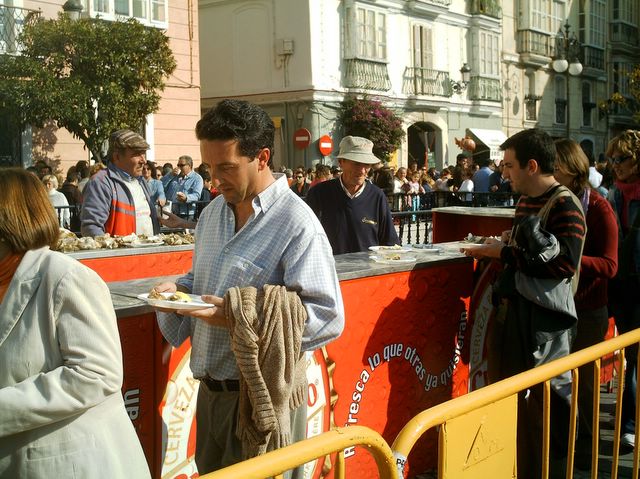
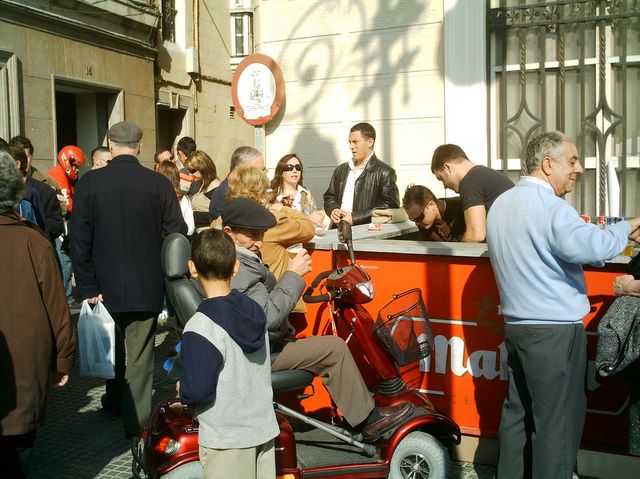
By the time my girlfriend and I arrived at Ostionada on Sunday, the first chorus/band had already played and finished and the line leading to the official city stands – full of free beer, glasses of sherry, pickled peppers and, of course, plastic plates piled high with raw oysters and lemon wedges – was already as far as the eye could see. It was two o’clock in the afternoon. We decided to pass on the free oysters and booze this time and went over to a private stand where I bought a large cerveza for half the price they would normally be selling it. As for the oysters, we figured we would try them another day. There was a lot of cheap beer to drink and, as far as my girlfriend was concerned, loads of pictures to take. As she ducked in and out of the crowds happily snapping away, I stood in the middle of the square contently sipping from my cold cup and listening to the current chorus. I lifted my eyes and looked around. Loads of people (15,000 by today’s newspaper estimates) stood with their families and friends. Some were drinking from glasses while others were slurping from shells. The booze was ridiculously cheap – even free if you were willing to wait long enough in a queue – and the food was plentiful. Good cheer filled the jubilant atmosphere. It was just like Carnaval. I knew this was a true fiesta, if anything, because Granny and the little sister had tagged along too. A real fiesta in the spirit of Carnaval isn’t just for unemployed people in their twenties and thirties who still live at home, it’s for the whole family. Its’s a time for all generations and all loved ones, regardless of age or occupational status, to drink loads of cheap alcohol and slurp down tons of raw seafood to the point of vomiting from food-poising – and to do it together. It almost brought a tear to my eye as my girlfriend eventually found me in the crowd and said, "I got a great picture of this drunk guy at a stand trying to pry open some oysters!"


"That better be an oyster between your legs, mister."


This guy definitely isn't a Gaditano...
"Why the hell did I spend two hours in line for OYSTERS?!?"

We stayed at Oyster Fest for most of the afternoon and, as far as I can recall, it was the only time siesta didn’t seem to occur in the south of Spain. First 3 o’clock, then 4 and 5, all came and went without the slightest hint of the masses getting restless and heading home. I suppose when it comes to having to choose between siesta and fiesta – especially one where there’s free stuff to be had – the latter always wins out. We, however, had had our fill by then. My girlfriend took her last few shots of Gaditanos and their event as I ordered one last beer and drank it... soon to be homeward bound.


Everyone has the right to a little pre-CARNAVAL fun, even the good ol' room mates


"Hey guys, I hope we don't stay too long.
You know I DO have school tomorrow."

We only re-emerged from our cozy abode hours later, after the sun had set, in order to go and meet some friends for our traditional Sunday night game of Scrabble and chess. As we crossed the square where Ostionada had begun all those hours ago, we were surprised to see that there were still some fiesta-revelers – again mostly twenty- and thirty-somethings – going strong. (Who am I kidding? We weren’t surprised in the least to see them still there!) They were still slurping away and drinking merrily, and would most likely continue doing so well into the wee hours of the night. After all, they probably didn’t have any job to go to in the morning and Gran’Ma would happily be keeping the bedroom’s midnight oil burning. The only person they’d have to be careful not to wake while stumbling home drunk was the little sister – she’s one of the few people in the household who actually has to do something in the morning and go to school.


When there's free beer to be had, who knows how long the fiesta can last?

As for now, the only hard part for the Gaditanos is that they’ll have to wait until the end of February to experience Carnaval again. They actually have to wait for the real thing this time. That is, unless of course there’s another pre-Carnaval in the not too distant future... Anyone who knows the locals and knows how fiesta courses through their veins won’t be surprised to hear that there is. Next week’s city-sponsored weekend festival is Erizada, or Sea-Urchin Fest. As far as I’m concerned, a fiesta in honor of, and which serves, sea urchins is not something that deserves celebrating. But then again, when you haven’t worked in three years, can’t get your girlfriend past the bedroom door or Granny, and your kid sister wakes you up each and every morning as she gets ready for school – you need SOMETHING to occupy you from between now and Carnaval ...And a fiesta in honor of those thorny bottom-feeding invertebrates seems like just the thing to do it.