12/05/2005

Avast, Ye Mateys! [DECEMBER 4, 2005]

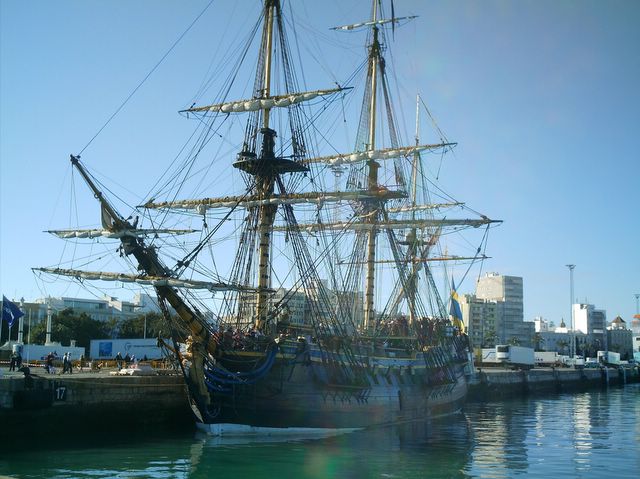
Well, we’ve had a pretty exciting past couple of weeks here in Cádiz. A trading boat from the Swedish East India Company, the Götheborg, had been sitting in port replenishing her cargo and supplies for the long months ahead as she prepared to round the Cape of Good Hope and head to China. The last we saw of her was on Monday, though, as the beautiful lady set sail for her next destination. The Chinese trade, they say, is a lucrative one and the wooden vessels come back from the Orient filled to the brim with treasures undreamt of. Porcelain, tea, and exotic spices are but a few of the riches they bring us Europeans. I wouldn’t mind joining the Swedes on their journey – if it weren’t for the threats of jaundice and scurvy on the high seas – but I’m a lowly lily-livered land lover. Arrgh, her blue waters are no mistress for an English teacher/amateur writer such as I. I would have probably ended up spewing forth all over her polished starboard (Or is that the port-side? I always get the two confused...) as the lass set off on her treacherous journey to the East.


FIRE CANONS OFF THE PORT!!! (Or was that the starboard?)

Aye, aye... I know what you’re thinking, but this is not a historical piece and I’m not talking about the XVII or XVIII Century. There actually was a boat from the Swedish East India Company, a wooden vessel and fine seafaring specimen she was, arrgh, sitting in the modern port of Cádiz as tankers, cargo-ships, and cruise-ships were conducting business as usual. But now, instead of plundering the rest of the world and bringing riches back to Europe so that we on the continent might powder our wigs and scoff at the primitiveness of others, the Götheborg is actually sailing around the globe on a diplomatic "public image" mission. The crew are no longer a motley bunch of cutthroats and vagabonds lured onto the Seven Seas by promises of adventure, glory, and untold wealth, but well-educated multi-lingual tour guides willing and able to answer any questions you might have about their country. These Swedish buccaneers no longer brandish crooked daggers and deadly muskets, but hand out pamphlets and set up tents filled with informative little tidbits about that country to the north none of us really knows all that much about. Yes, the Swedes have come a long way since the 1700s. And they’ve even managed to open up a few IKEAs in the meantime.


Thar she be in all her beauty... Tis a fine vessel worthy of the name GÖTHEBORG

The Götheborg, as our multilingual Swedish tour guide told us in impeccable English, will be following the original journey of other ships that once sailed for the Swedish East India Company and will also be stopping off and informing the locals about the nation of Sweden and its customs. But don’t you worry! We have been assured that they have more than enough pamphlets printed in the appropriate languages to answer any questions that might be posed by other visitors in Brazil, South Africa, Australia, Indonesia, China, Singapore, Malaysia and by the helpful employees of the Suez Canal that will undoubtedly ask them what the hell are they doing sailing around the world in a wooden ship from the XVIII Century.


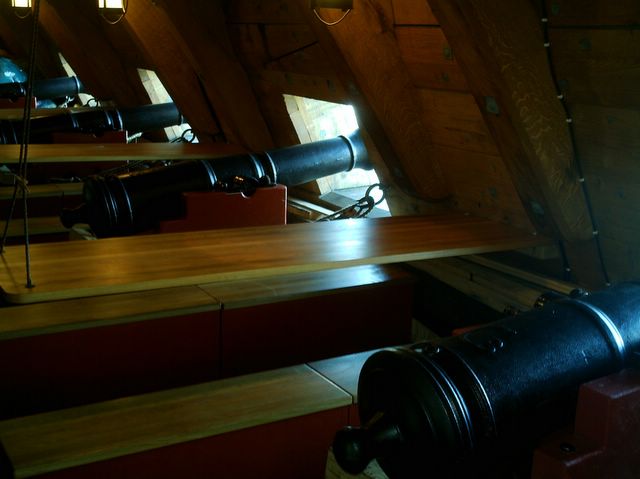
My girlfriend's lovely picture from the deck which
she begged me to include with this article

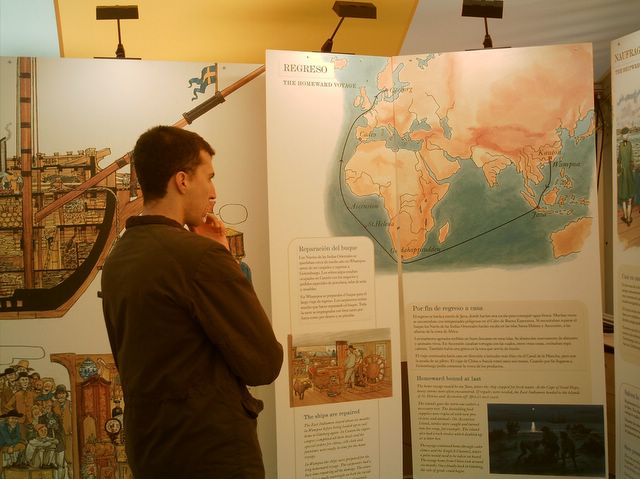
After I had absorbed all the Swedish trivia I could, it dawned on me to seek the answer to the one burning question that was on both my girlfriend’s and my mind: What on earth does a wooden Swedish ship have to do with Cádiz? Well, our blonde Scandinavian tour-guide had an answer to that one too. In fact, she had something even better – a tent containing an historical exhibit written in both Spanish and English.


Historical images of the port of Cádiz and maps of the old trade route to the East Indies

As it turned out, once a viable sea route was discovered to the Kingdom of China, merchants from Europe were eager to begin trading and reap the financial benefits that such a route could provide. In 1587, the Portuguese established the first East India Company and, throughout the 17th Century, they, along with the Dutch, British, and Spanish, controlled a monopoly on Europe’s insatiable thirst for tea, porcelain and spices from the Orient. But the Swedes soon battled for an opportunity of their own and, in 1731, the King of Sweden founded the Swedish East India Company. That’s where Cádiz comes into the picture. The only things the Chinese wanted from the Europeans was silver and the Spanish had a lot of it. So, before setting off for the long journey to Canton, the Swedes would stop off at Spain’s southernmost and busiest Atlantic port, a.k.a. the place I call home, and sell the Spaniards some quality Swedish goods in exchange for newly minted Spanish silver coins which would then be used months later to buy goods from the Chinese. Confused yet? Not quite sure what on earth the Swedes could possibly sell the Spaniards that would fetch them that much silver and make it such a profitable venture to sail halfway across the planet? Well, the Swedes sold them plenty of rope and, most importantly, quality furniture with a sense of style specifically designed for the modern fashion conscious homeowner... all at a low, low reasonable price. I guess some things just never change.


IKEA - "affordable solutions for better living"

But alas, the Götheborg has now set sail and departed the ancient port of Cádiz. She’s probably somewhere in the middle of the Atlantic now, steadily steering towards her next destination as her crew prepare to set up tents and hand out those countless pamphlets. I, for one, will miss those Swedish swashbucklers. The sight of tall, blond men and buxom blonde ladies roaming the streets of this Spanish port were a welcome relief from the countless short and dark-haired locals one is used to seeing. And even if those blonde sailors from the north were nothing more than, arrgh, the notorious Scandinavian scourge of the North Sea, well this ol’ land lover wishes them a safe and tumult-free journey as they brave the high seas. Canton and numerous other cities await, ye brave adventurers... as does another market for your well-crafted and stylish, yet affordable, interior design products.

11/28/2005

Old World Charm [NOVEMBER 27, 2005]

Well, another Thanksgiving has come and gone and for all of us Americans away from home, expats and travelers alike, thoughts inevitably flock back across the Atlantic. Sure, we make do with what we have here in our newly adopted countries, but some stuff will always just seem strange to us. During the holidays, above and beyond all other times of the year, these differences seem to shine the brightest. Holidays or not though, it’s plain and simple. No matter how long you stay in a foreign land and adapt, certain things will always appear to be exactly as that land’s moniker had promised when you initially set off – foreign.

It’s the small things that first come to mind. Such simple objects as the can openers and milk cartons that they’ve got over here are still as perplexing as particle physics to me. I have no idea how my girlfriend manages to successfully extract those juicy mushrooms from inside that cold heartless tin she just bought at the supermarket without requiring a Band-Aid or tetanus shot afterwards. And don’t even get me started on the milk cartons they’ve got over here. I always stare in amazement as she delicately tears open the top corner of the box without spilling its content all over the kitchen table. Keep in mind, these oddities aren’t just Spanish phenomena, but are commonplace all over the continent. They’ve been a nightmare for me from Athens to Prague to Madrid.


You expect me to open that milk and use that can opener?

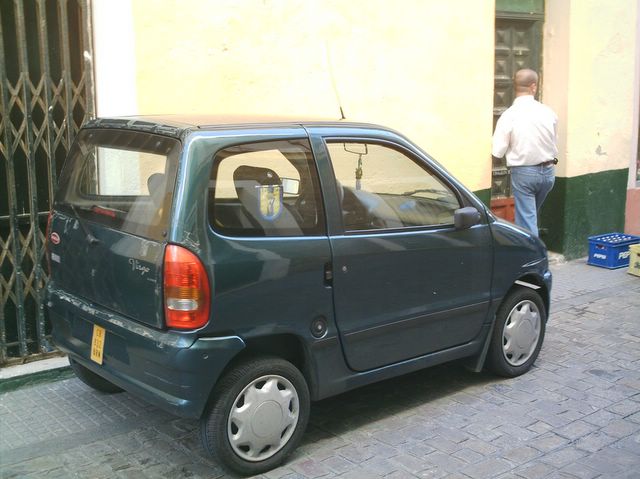
Another one of the small things that, as an American in Europe, I’ve had to get used to is ...(How else to put it?)... how small things actually are. Everything is smaller here in the Old World. From the cars to the swimsuits to the streets to the female waistline, nothing is as large as its American counterpart. The word "supersize" hasn’t entered the lexicon over here yet. That inevitably means that everything that was normal in America back in the day is still normal here. Most people still buy a 330ml (10oz) can of Coke as opposed to the Big Gulp or liter of soda most people back home do. Cafés still sell coffee in one size or, if you’re lucky, in the good ol’ variant of small, medium, or large. There’s none of that Yuppie tall, grande, or venti crap over here. And if you’re looking to get a jumbo Party Pack of potato chips at the corner store, sorry but you’re out of luck. There’s only one size here – small. You need to buy two bags or go for a single and throw in a pack of nuts. A little variety never killed anyone.

But it’s not only the food that’s smaller. All the systems of measurement are too. Now I know that the US is practically the only country on the planet to use the antiquated Customary Unit system, but I still can’t get used to this whole Metric thing and I’ve been trying for over four years now. Every time I step on the scale, I’m surprised at how light I am (2.2 pounds is equal to 1 kilogram) and every time I go to the doctor and he scribbles down my height, I’m surprised at how short I am (1 meter is equal to 3.28 feet). Nowadays, when a European asks me how tall I am or how much I weigh, I usually just reply, "Normal," because if I get into the entire Metric conversion thing, I’d probably end up telling him I have as many kilograms as a grizzly bear and as many meters as that Chinese guy who plays basketball for the Houston Rockets.


Now THAT is a compact car!

The thing that really confuses me when it comes to the Metric system, though, is the temperature. I don’t care how many times someone tells me 44C is stiflingly hot, it still sounds like 44F to me and, in my book, that’s cold. I never know whether to take my coat with me or a light windbreaker when I step outdoors. And the fact that it’s usually so unseasonably warm down here in Cádiz doesn't help either. I used to just stick my hand out the window and try to figure out the temperature that way but it doesn’t really work that well in our current apartment. So, I’ve recently resorted to just going to the front door, popping it open and sticking my head out. If it ain’t cold and the sun’s a-shinin’, then that winter coat is staying right where it is.

Then there’s the appliances. That’s one thing I really do miss about home and it really became evident over the holiday. We tried to buy a turkey for Thanksgiving and shove it into our oven but it didn’t fit. Of course, like everything else here, our baking machine was too small. Granted, we only own a toaster oven but my girlfriend and I are still better off than a lot of Spaniards we know. For some reason, a lot of people here don’t believe in ovens. Anyway, we had to make do with a chicken this year but it still came out deliciously, although the carving (You ever try to carve a chicken into presentable slices?) left a little to be desired.


My TV and oven competing for the "Biggest Appliance of the Apartment" trophy

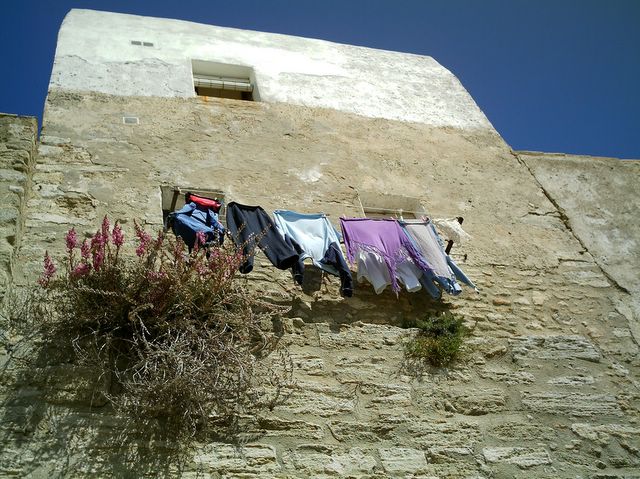
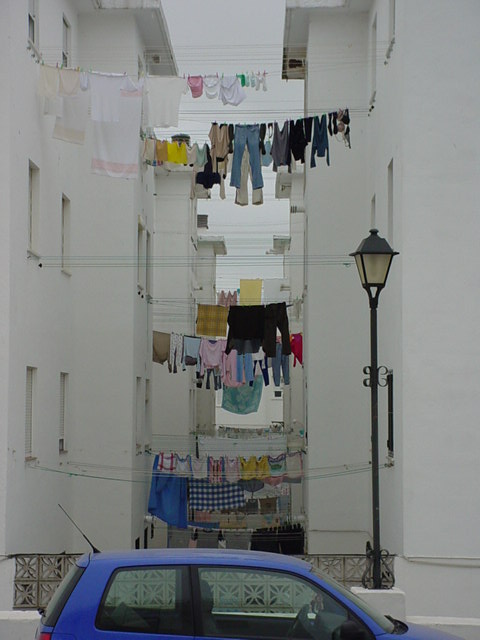
Another appliance that is lacking all over the continent, at least as far as I can tell, is the dryer. I always used to think that the term "washer & dryer" went hand in hand but apparently not so here. Who needs a dryer, the local wisdom goes, when you have a perfectly good roof or window to hang damp clothes out of? And while you’re waiting for your clean underwear to dry out the window and watching TV on that small set that’s as big as your oven well... Don’t even get me started on how much I miss that big screen back in Philly.


Who needs a dryer when you've got a window?

But it isn’t all that bad I suppose. When you stop and consider it, there are a lot of advantages to having smaller things, like they do here in Europe, as opposed to the luxury large editions we have in the States. I hardly ever see any SUVs hogging the road and the small cars here are both fuel efficient and environmentally friendly. The fact that appliances are smaller here and therefore consume less electricity means that the bills are never too high and, again, help guarantee a less polluted environment. Now that I think of it, although I’m stuck in a foreign land with Thanksgiving behind me and Christmas right around the corner, there must be all kinds of advantages to doing things the way the Europeans do. Far too many to mention here...

11/14/2005

Doggone It! [NOVEMBER 13, 2005]

I never thought that I’d find myself walking down the old, winding streets of a three-thousand year old city carrying a bagful of shit in my right hand. Not only that, but I scoop up the still steaming shit (only the fresh ones will do) from the ancient sidewalks myself and, even worse, I do it practically every day. How low can one man sink? I hang my head as I write this because I’m sure some of you will think I’m finally revealing that twisted fetish you all knew I had, but I assure you I’m not – It’s just that I am now a dog owner.

I’ve never been a big animal lover. Sure they’re cute and I’ll stroke the occasional domesticated critter, but pet ownership was just never for me. I put this down to two things: One, I’m violently allergic to cats. Two, my pet rabbit, Fluffy, jumped off our balcony and plummeted two storeys to his ultimate demise when I was but a wee lad. The authorities at the time, a.k.a. my older brother, concluded that it was suicide brought on by depression as a direct result of my pet ownership abilities (or lack thereof). Whereas I eventually got over Fluffy’s untimely hara-kiri, the cat allergy has stuck with me throughout adulthood and, as a result of these physical and mental issues, so has the aversion to having animals live under the same roof as me.

All this changed, of course, when I started dating my girlfriend. She loves dogs. All Czechs do. They have a saying in the Czech Republic, "If you don’t like dogs, you don’t like people." Frankly, I’ve met plenty of antisocial misanthropic Czechs who absolutely adore mutts but, hey, I’m just a stupid foreigner so who am I to point out these obvious non sequiturs. The one thing that I did have to get used to was that she was a dog owner and so was everyone else in her family. The only relative I have who owns a dog is my retired uncle who lives in the mountains and loves hunting. But that’s what love and relationships are all about. Compromise.

When my girlfriend and I first moved to Spain, she had to make one of the hardest decisions in her life, or so I’ve been told by other dog owners, and leave her faithful friend behind in Prague so that she could travel across Europe with her adventurous boyfriend. This, I’ve been told by dog owners again, proves that she must love me.

After we returned from Prague this summer though, we finally brought her dog with us. The two would be separated no longer. We thanked my girlfriend’s sister for looking after the Labrador Retriever for the past year, put her in one of those airplane dog cages (which set me back over 150 bucks!) and flew her down to sunny Cádiz.


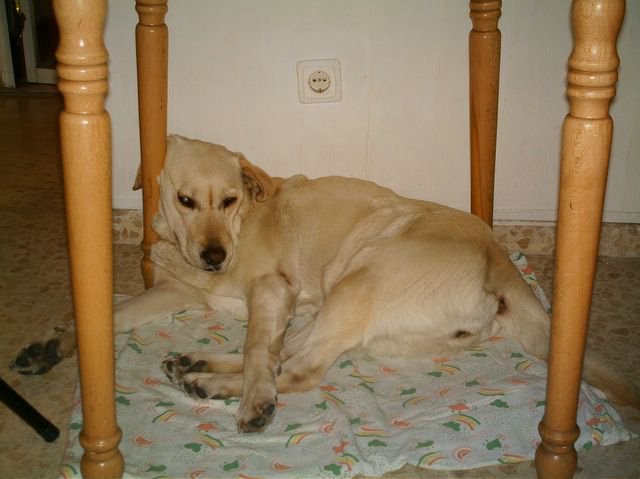
Just chillin' out at home

Ema, the Lab, has been living with us for about two months now. At first, I didn’t want her here at all. A dog in my home? I thought. That means barking at ungodly hours of the night, chewed up slippers left and right, and surprise deposits of urine waiting in the living room corner. But Ema’s been great. She’s completely house broken and trained. The only time I’ve ever heard her bark is when my girlfriend says "Bark!" in Czech. In fact, Ema doesn’t really do anything at home... unless you take sleeping into account. The thing is, she really isn’t that old so I don’t see why she’s passed out and snoring on the floor half the time. I guess blindness will do that to a dog.

That’s right, I said Ema is blind. It’s quite ironic actually. Labrador Retrievers are world-renowned for being used as seeing-eye dogs. Our Lab can’t see another dog’s ass even if it’s an inch away from her face, although she has recently learned how to sniff out that kind of thing a lot better. I guess one day, when we can afford it, we’ll buy Ema a Labrador of her own so that she won’t bump into walls anymore.

In the meantime, we’ve been having a grand old time here in Cádiz. The first few weeks were a bit strange for all of us and took some getting used to but we’ve gotten over those initial stumbling blocks. Just a few words of advice, though, for any dog owners out there who decide to bring their blind four-legged friend – especially if they come from a landlocked country like the Czech Republic – to the ocean. Be prepared for prolonged fits of canine coughing after your first visit to the beach. Your blind dog will think that the big wet thing that just soaked her paws is not the Atlantic but a lake. She will therefore begin to lap accordingly.


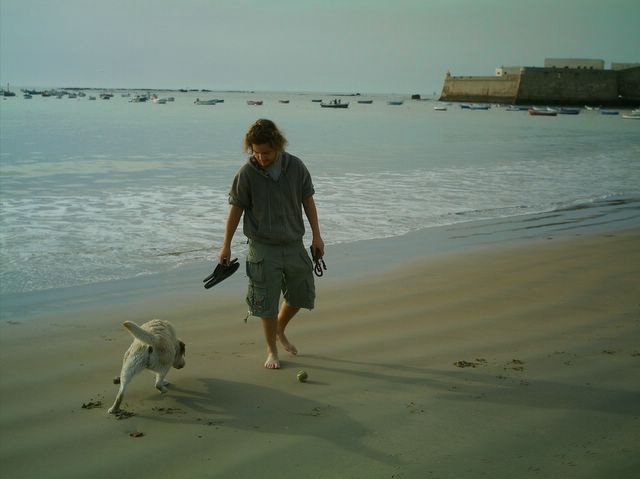
You gonna throw it again or what?

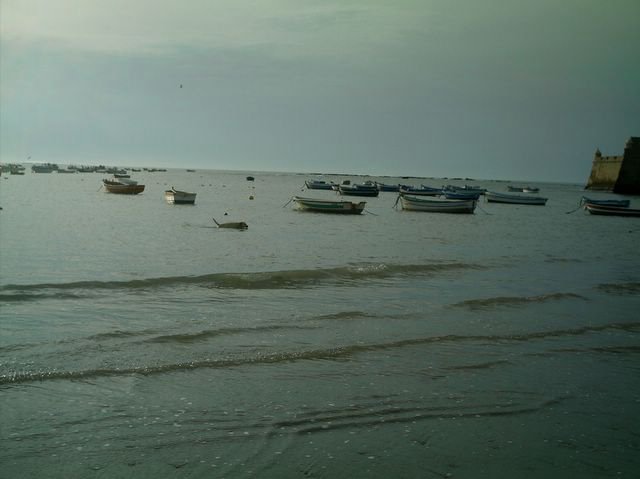
Another thing to be careful of is throwing the ball. Everyone knows dogs love chasing after tennis balls and it didn’t take me long to find out that Ema was no exception. Sure, it takes a blind dog a bit longer to find what she’s looking for, be she still gleefully goes on her merry way and doesn’t give up until the ball is firmly fixed in mouth. Throwing a ball to your blind dog on the beach is no problem, but whatever you do – DO NOT THROW IT DEEP INTO THE OCEAN! Ema jumped into the Atlantic the first time I launched that fuzzy green sphere in there and began wading aimlessly towards the horizon. Being blind and all, she had no idea where the ball was so she just kept wading... and wading... and wading. Further and further away. Thank God my girlfriend and I eventually caught her attention by throwing a few stones and yelling at the top of our lungs. If we hadn’t, Ema would be halfway to New Jersey by now.


Look closer... there's a blind dog among the vessels

So far, these brief anecdotes form the limits of my dog experience. I’m told there’s a lot more to expect though. Apparently, she menstruates only twice a year and, either before or after it (I can’t remember exactly), she tries to jump on any erect male that crosses her path. I’m told it’s pretty hard to stop her but I think preventing a blind dog from sleeping around can’t really be all that difficult. I’ve also been warned that she occasionally goes through bouts of farting but I haven’t had the opportunity to smell that yet. Oh, and she’s recently started this whole shedding thing. I thought the dog was going bald when it first happened but I was soon assured that it was all completely natural. My girlfriend, as a result, has had to sweep the floor two or three times a day for the past week but I don’t really see a difference. Ema still just sleeps away in her quiet little corner, waiting for an opportunity to chase after that mangled green ball that sits next to her water bowl.


Doggone it! It's right here you sightless mutt!

As for me and the whole idea of living with a dog, I must admit... It’s really not that bad. Don’t get me wrong, I can’t think of anything nice about walking down the street carrying a bagful of warm excrement or praying to God that Ema doesn’t "take care of business" in front of the busy outdoor café. But every time I come home and that tail of hers starts wagging like mad simply because she’s so happy to see me, I stroke her smiling head, scratch her behind those velvety ears, and wonder why it’s impossible not to love her back.

11/06/2005

Something Smells Fishy In There [NOVEMBER 6, 2005]

Humanity has come up with some pretty strange celebrations in the name of tradition. Some cultures dip their newborn babies into water, others have them circumcised before they can even blink, and still others order their young men to join the military (and become killing machines) before they can truly be considered adults capable of respecting others. But these are all but unique traditions. Things most people go through only once in a lifetime. The most exquisite of traditions aren’t the ones that we see but a single time throughout our many years, but the ones that happen again and again, year after year. And there’s no time of year when these types of traditions get stranger than at the end of October and beginning of November.

Christianity has All Saints’ Day, the Brits have Guy Fawkes Night, and we Americans – along with most of the Western world it now seems – have Halloween. I thought we had the world beat with Halloween. I mean, how can any culture possibly have a stranger tradition than that one? A bunch of kids go around their neighborhoods asking for either a trick or something sweet and, if they’re lucky, they get the fright of their life after Dracula pops out of the closet. Keep in mind, the Count is popping out of the closet of some stranger’s house and telling little five year olds, "I VANT to SUCK your blood!" If that happened on any other night of the year, the police wouldn’t go long without a disturbing complaint from a frantically concerned parent. But, on that one night, mom and dad tell their frightened little one, "Oh Honey... It’s nothing to be scared of...." Even E.T. got to walk around the town during Halloween and no one was the wiser! There can’t possibly be a stranger yearly tradition somewhere else in the world, now can there?

Well, curiously enough, there is and it happens every year here in good ol’ Cádiz. It doesn’t happen all over the city as Halloween does in towns back in the US, but only in the central food market. Why this is will make perfect sense once I explain what exactly it is that goes on during the festival of Tosantos (As the people of Cádiz pronounce Todos Los Santos, or All Saints).


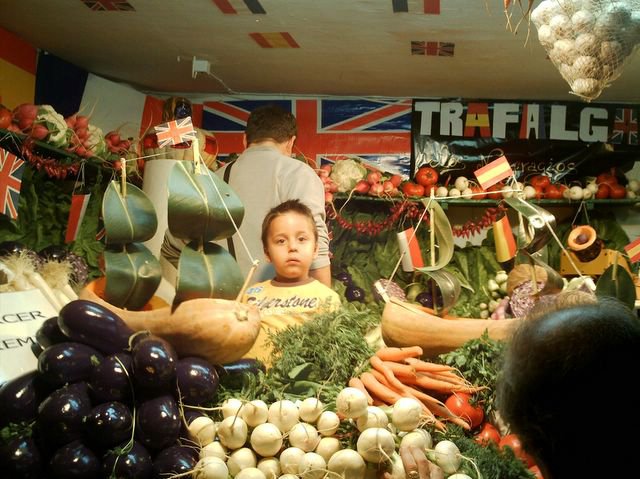
Welcome to TOSANTOS - You're in for quite a treat!

The official Cádiz food market, Mercado Central, is a large one-storey building that occupies an entire city block in the center of the city. It has provided the residents of Cádiz with meat and produce for hundreds of years and continues to do so till this day. Sure there are supermarkets elsewhere, just like in any other modern city in Europe, but if you want the good stuff or the hard-to-come by fish and pork fillets, you go to Mercado Central. The market itself is divided into three sections – fruit and vegetables, meats and cheeses, and fish. This past Monday all three were closed as the mongers within labored away in preparation for their big night. They were dressing their food.


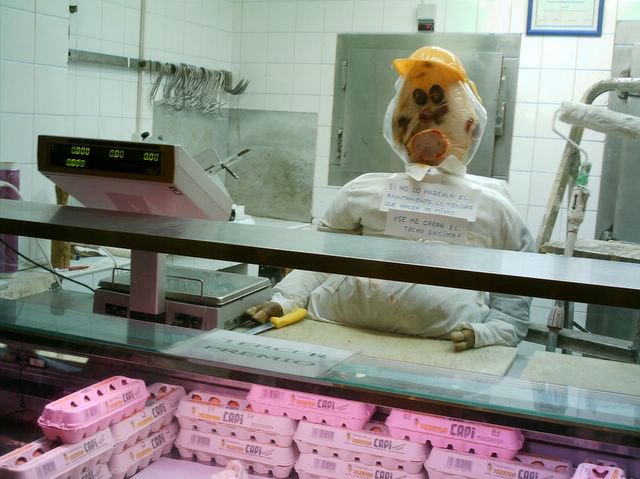
Was that butcher made out of...? Don't even ask.

That’s right, I said dressing their food. And I’m not talking about a bit of parsley on the side. Mama always said don’t play with your food but I guess the matrons of Cádiz have never heard of it.

My girlfriend and I first entered Mercado Central that evening through the produce section. It was almost too comical to believe.
There was a tourist groups of nuts (walnuts if I remember correctly) visiting a scale model of the Egyptian Pyramids and surrounded by camels made of potatoes.


These Spaniards have got to be nuts

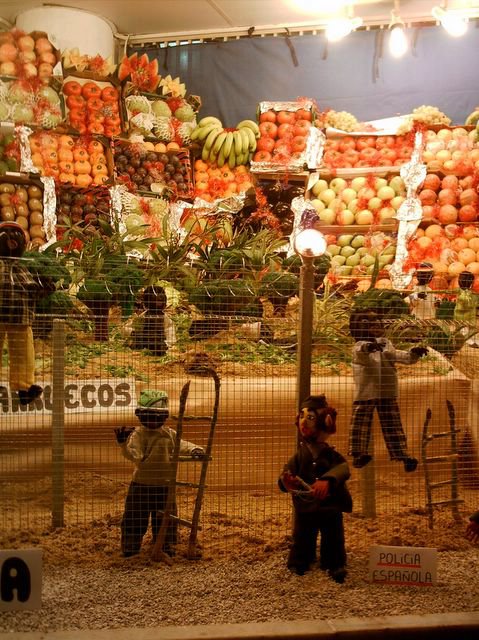
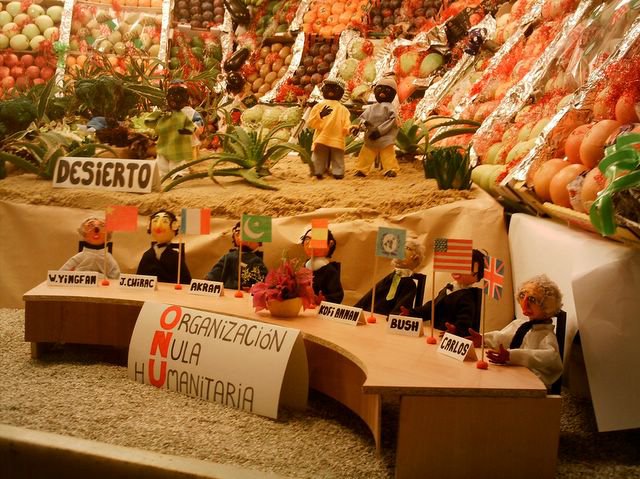
Another produce-peddler had changed his juicy citrons and kiwis into an elaborate crossing-the-border scene as illegal African emigrants tried to scale the fences which guard Spanish enclaves in North Africa. Next to them stood the council table of the United Nations as Bush, Chirac, and others discussed what could be done to alleviate the problem.


A better life awaits on the other side................ But should we let them in or not?

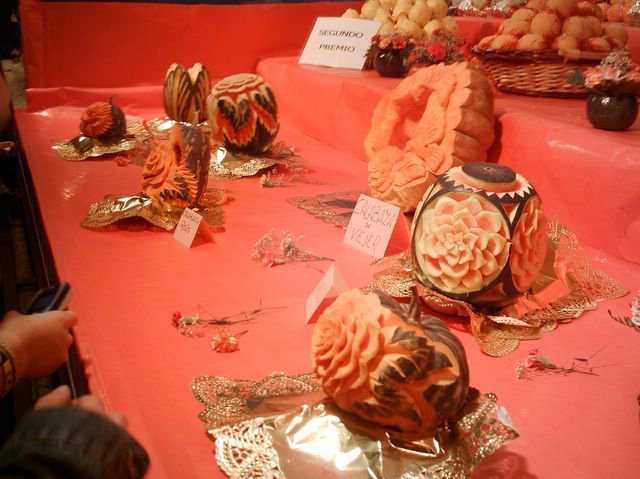
Another vendor forgot about dressing and arranging his melons and simply sculpted them, putting what I normally see carved on pumpkins back home in Philadelphia to shame.


A fruit-man by day, sculptor by night

But fruit and vegetable decoration isn’t that strange, right? After all, we have carved pumpkin too. Well, that’s where the meat and fish sections of Mercado Central come in. The night of Tosantos, the fruit pushers aren’t the only ones that have fun, the butchers and fishmongers get in on the action too.

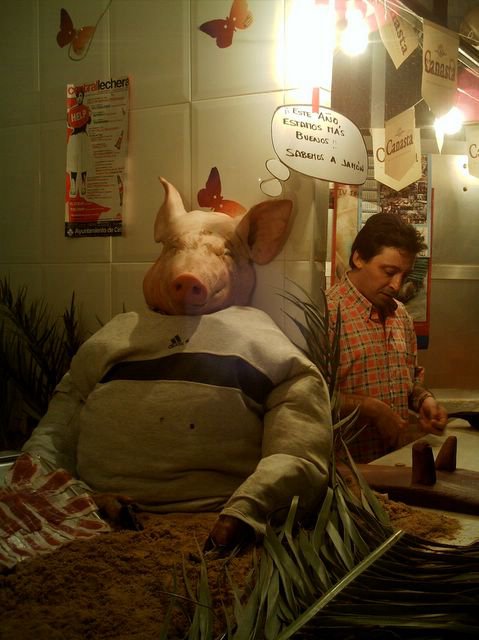
The pigs were what first caught our eyes.
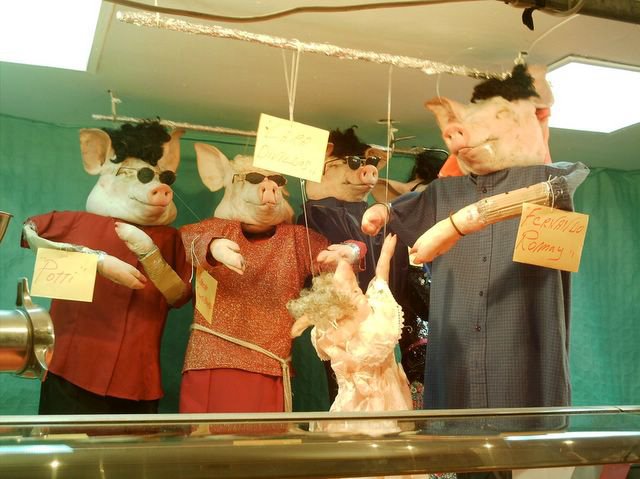
There were pig families dressed in elegant clothes dancing in front of television cameras.


Tonight on the Ed Sullivan Show

There were couch potato pigs eating ham – of all things – and watching us walk by.


Nothin' to do but hang out...

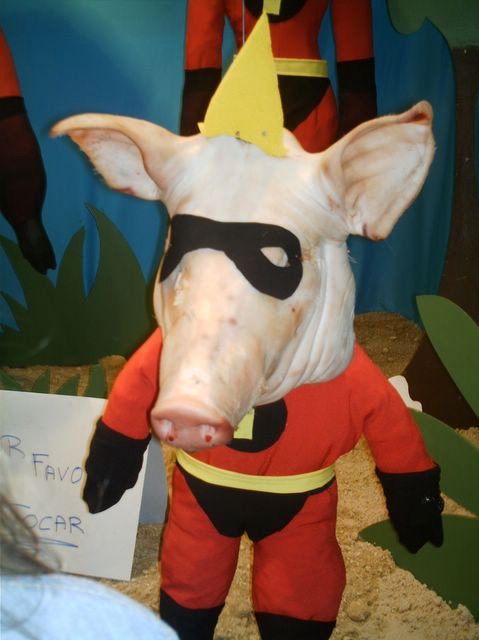
Even the family of the animated film, The Incredibles, showed up wearing what must have been their newly designed pig secret identities.


Is that THE INCREDIBLES in Cádiz? .............................. And they even brought the baby along

There were big pigs, little pigs, fat pigs, thin pigs, pig heads, pig feet... you name it. And, keep in mind, when I say pigs, I mean REAL pigs. The heads and hooves and whatever else is left of the animal when the butcher is done his business. Most of us don’t usually see these things because when we buy meat in a supermarket, we buy it in a nice little vacuum-dried container wrapped with sterilized cellophane. Who’d even think that our porkchop came from that same animal dancing about on the counter in the cute little outfit?

The pigs may have been disgusting and crowned Tosantos as the officially strangest "end of October/ beginning of November" tradition, but one sight at what lay in store for us in the fish section gave the festival the most repulsive crown as well.


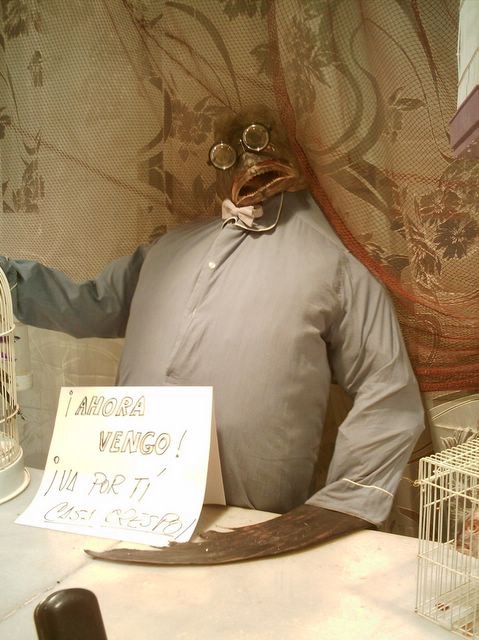
You gonna come in or just stand there all day?

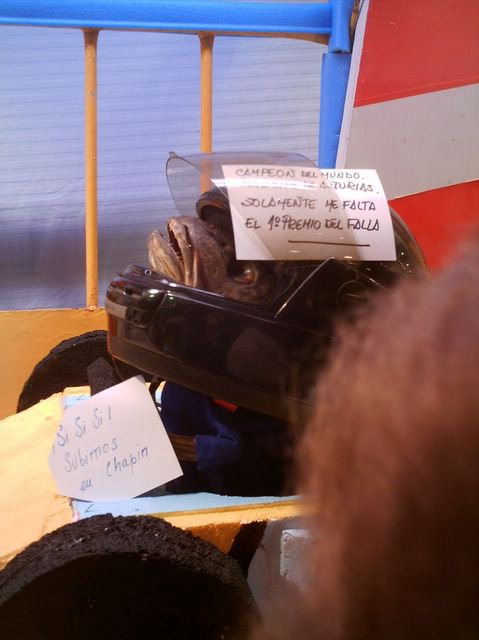
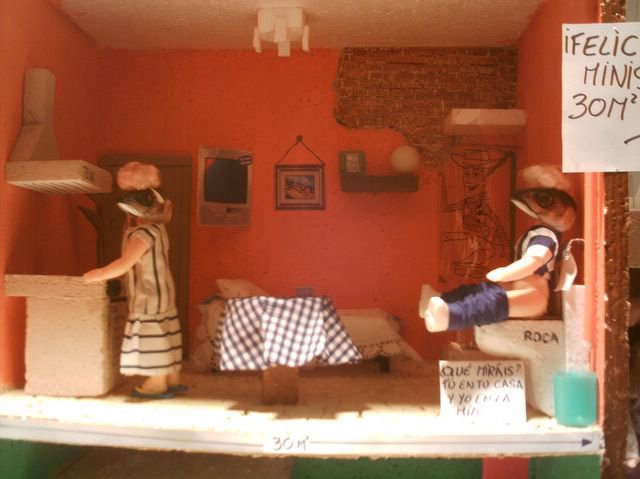
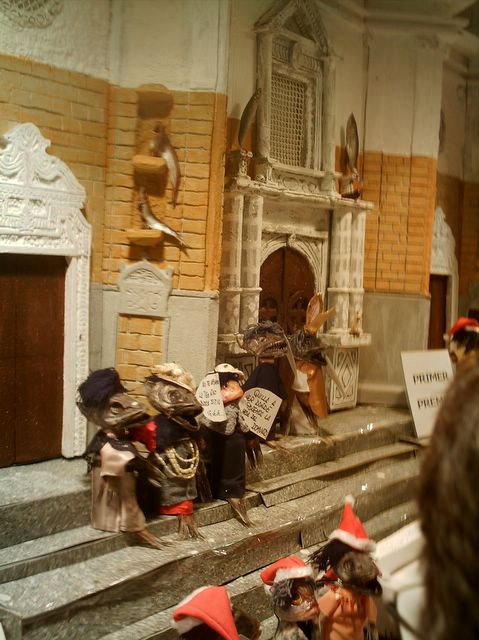
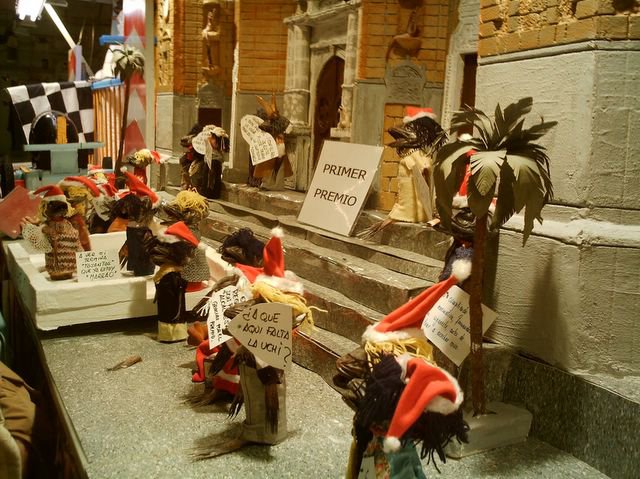
Dead rotting fish lined the walls of Mercado Central’s inner most sanctum. I was accustomed to seeing fresh tuna, still jumping shrimp, squid of all shapes and fish of all sizes on display at the stalls there. But nothing prepared me for the grim picture of decaying sea-life that awaited us that day. As my girlfriend’s camera clicked away, I pushed my way through the thronging crowds (mostly families with young kids) and soon found myself, along with all the Spaniards around me, laughing at the witty comments posted by each fish and admiring the creativity of that particular fishmonger.


Go Fish-Racer, GO!


Jeez, can't a fish have a little privacy every now and then?


Fish in their natural habitat: Singing in a choir on the Cathedral stairs


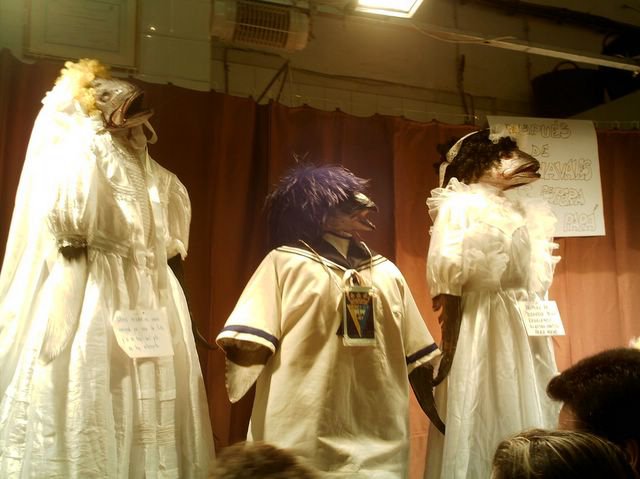
Looks like the Little Mermaid finally got that wedding she always wanted

I know... I should have cringed at the grotesque pig heads and been repelled by the dead fish dressed in wedding dresses (not to mention those in race-car helmets), but the happy-go-lucky attitude of Cádiz is just so damn contagious I forgot completely about how disgusting it all was. That night alone, we were no longer foreigners. We were one of them...

Only after we had done our rounds through Mercado Central and my girlfriend had her fill of pictures, did the repulsiveness of it all finally strike us. We held our noses – the mingling stench of rotting fruit, fly-infested pig parts, and days-old fish heads had by then become too much to bear– and finally walked away from Tosantos, confident that no matter how strange Halloween may be, nothing could beat what we had just witnessed.

10/31/2005

What's All The Buzz Around Doñana? [OCTOBER 30, 2005]

We stepped out of the boiling car and into the Andalucían wilderness. The thick shrubs that encircled us allowed for a fleeting glimpse of the wetlands beyond. I squinted my eyes and tried to spot some of the national park’s famous flamingoes in their natural habitat.
"Hey, anyone see some flamingoes?" as I batted away a fly that had landed on my neck.
"No... Wait a minute! What’s that?" our friend asked as she swatted in much the same way I had just done.
"No, no, no. That’s a hawk. Or maybe an eagle," her boyfriend answered as he slapped his arm.
We all continue looking and swatting aimlessly when my girlfriend interrupted,"These flies are driving me CRAZY!
"Yeah, this is a bit ridiculous."
"My God, they’re EVERYWHERE!" as I felt something, somethings, landing on my face. "What the... They’re attacking me! Feeding off of my beard!"
"Me too... Can’t... get... rid... of them."
"That’s it!" my girlfriend yelled. "I’m going back to the car!" She walked back to the searing metal box, arms waving maniacally in the air, and opened the door. A cloud of flies emerged from within. "They’re... They’re... Everywhere! In here too!"
"But we JUST got out of the car!" We had parked and left the windows open, hoping that it would alleviate some of the heat in our air-conditionless Opel. Not even five minutes had gone by.
It felt like we were the unwitting victims in some 1960s Zombie flick gone horribly wrong. "Everyone, quick! Back into the car! Let’s get out of here before they take over completely," I yelled.
We all hopped into the scorching four-door hatchback, windows still rolled down, and drove away to another section of the park as a cloud of dust picked up in our wake.

One of the things you miss about living in a city like Cádiz, nearly completely encircled by the sea and thoroughly urbanized through its three thousand years of existence (that’s right, I said Cádiz has been around for 3000 years), is nature. Back in Pennsylvania, where I’m from, you have so many trees, deer and squirrels that you eventually find nothing strange about strange mammals running across your lawn at strange hours of the day. Back home, we don’t use the popular British expression "like a rabbit in the headlamps" but say "like a deer in the headlights." It’s the same with my girlfriend. In fact, she misses the rolling green hills and wooded countryside of her native Czech Republic even more so than I do. Sure, Cádiz’s cobblestone alleys, Renaissance architecture and decaying Roman theater are nice, but sometimes you just need a little stroll through the forest. You need to get some green and fresh air. So, when the opportunity arose last weekend to take a nice afternoon drive with some friends down to Spain’s largest Natural Park and Wildlife Reserve, Doñana Park, we were as anxious as children on Christmas morning.

Doñana is a lovely place with a wide arrange of flora and virgin habitats. It is home to some 250 different species of birds, over half of them migratory, and 28 species of mammals, most of them in danger of extinction such as the lynx and Egyptian mongoose. The park itself is divided into many different sections but, as a whole, consists of nearly 1300 square kilometers of untouched reserve stretching from the Atlantic through the provinces of Huelva, Seville and Cádiz. At least that’s what our guidebook said. What we found when we first got there were those hordes of flies and countless shrubs. Now I know the ecosystem here in Andalucía is different than that of the Northeastern United States and Central Europe, but a park isn’t really a park without trees, now is it? Shrubbery, no matter how large, tall or plentiful, does not a park make. What it does make is shrub-land and, in my opinion, shrub-land is only one step better than the Sahara when deciding where to take a nice Sunday stroll.
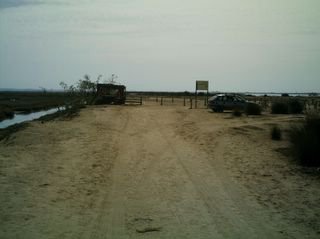

Ah, there's nothing like a lovely stroll through the park

But, as I said at the beginning of this article, we quickly left the first place we stopped at in Doñana. We headed off in the Opel with our windows rolled down and the dusty wind blowing in through the windows which, temporarily at least, seemed to keep the vehicle’s flies at bay. We drove through the shrub-land on the bumpy dirt road for a while when we spotted a sign. "Bird Observatory –› 10KM" What the hell? we thought. An official bird observatory might be the perfect place to get a reprieve, no matter how temporary, from the unbearable heat and insects that seemed to be following us everywhere. There would probably be some exhibits and park rangers there to help us enjoy our wildlife experience too. And maybe, just maybe, we’d finally be able to see some flamingoes.


The Bird Observatory must have taken ages to build!

Well, after about fifteen grueling minutes on the crappiest road ever built by man, we made it to the observatory. There were no park rangers, no exhibits, not even a W.C. In fact, there wasn’t even a building. The official park observatory was nothing more than a makeshift bamboo wall with a hole cut out in the center. That was it. It overlooked the shrubs and, if you looked for long enough and far enough, you could make out a bird or two. They didn’t look like flamingoes though.... The closer I looked the more they resembled the seagulls I see in Cádiz every day. After swatting a few more flies away, we decided we had had enough of Doñana. All four of us crawled disappointedly into the Opel and headed back along the same dusty road.
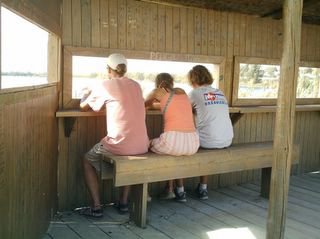

Observing... Making the most out of Doñana's tourist facilities

Thankfully, halfway back to the "Bird Observatory –› 10KM" sign, my friend (who was driving) had to water the shrubs. It turns out he had drunk too much water on the way there. So, we pulled over, he went to take care of business, and the rest of us walked toward the marshy wasteland a few meters to our left. Then we saw them... the flamingoes. They were beautiful. They were gathered in what must have been a group of thirty or forty, leg deep in the marsh-water, feeding on what algae they could find beneath. A few spread their pinkish-hued wings to fly away and we gazed in wide-eyed amazement at the glorious picture of pristine nature which lay before our unsuspecting eyes. The entire day’s troubles had been worth it... or so we thought.
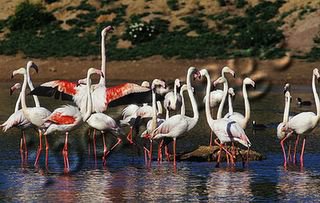

Breathtaking! It was all worth it

On our way back to the civilization we, once again, had to go through that first place we had stopped at in the park. To our surprise, close to one of Doñana’s entry gates, the locals from the bordering village of Algaida (not Al-Qaeda as I first thought) had invaded the park dressed in elaborate flamenco costumes and riding proud horses. They were preparing for the favorite Spanish pastime – fiesta. The colorful sight was so eye-catching that we decided to stop. How lucky, we thought, to be able to witness both flamingo and flamenco in one day. We found out a few minutes later that quick glances from a moving car can often be deceiving. In all the merriment and excitement we had completely forgotten about the evil little flies that lurked in the shrubbery. As we stepped out, they attacked us in full force but this time with reinforcements... giant mosquitos. We slapped and swatted away as the Spaniards, who weren’t bothered in the least by the countless insects buzzing about, continued drinking their wine, eating their tapas and dancing to their guitars. We were soon overwhelmed by the sheer number of pests and, realizing our mistake, jumped back into the Opel more than willing to sacrifice the show. Inside the metal deathtrap there was nothing but boiling and buzzing.
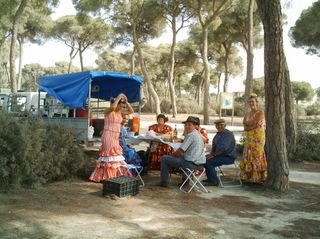

A fiesta in the depths of Insect Inferno - but the Spanish don't mind

"Get the hell outta here!" I shouted to the driver as we all swung our hands in a futile attempt to protect the little skin that had yet to be stung. "They’re... taking... over..."
He inserted the key and turned the ignition. Nothing. We glanced at each other in despair.
"Try again! The battery’s almost new! It’s not possible!" Our fingers crossed, we watched him turn the key once again. Still nothing. "For the love of God... NO!"
The horrible truth suddenly dawned on us. We were stuck in a sweltering car in an insect-infested park with people laughing and dancing flamenco all around. Forget 1960s Zombie flick – We had entered The Twilight Zone.
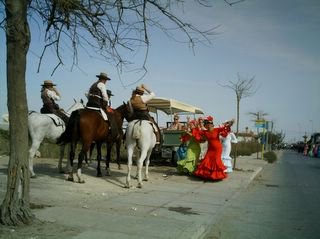

Don't take it personally Algaida, but we're gettin' the hell outta here!

The desperate situation called for brisk action. It wasn’t the first time something like this had happened to our friends so they took out the cables and asked some fiesta revelers for a jump start. To our relief, the engine was soon brought to life and we headed out of that hell-hole without looking back, laughing almost hysterically at the thought of what if the stalled engine had happened earlier in the day at the "official park observatory" miles from civilization. But we didn’t laugh for too long. Our happy chitchat was soon silenced when the engine died yet again, only fifteen minutes later. We needed another jump start. A quick glance around and we soon spotted our saviors. "Perdone las molestias..." The engine started once again but this time we set off for Cádiz with ominous apprehension.

Well, to cut a long and embarrassing story short, Spanish people proved to be very patient and helpful. My normally pessimistic girlfriend, for example, was completely taken aback when we stopped at a petrol station and asked the busy attendant inside the rest stop for help. She simply handed us the keys to her car, told us to "do what needed to be done" and continued serving customers at the cash register. Our thanks to all who helped!
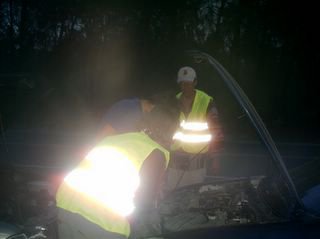

"Perdone las molestias, Señor..." but we need another jump

Despite this outpouring of kindness though, we still didn’t make it home. Ten kilometers outside of Cádiz on a narrow expressway overpass and in the rapidly fading daylight, the Opel died its last death. We could do nothing more without a mechanic – Shock treatment just wouldn’t bring it back.

Desperate and stranded, we called for help and received what we should have expected from a Spanish tow service, "What? Today during the weekend? How about we pick it up on Monday?"
"Umm, it’s in the middle of the expressway. On a narrow overpass. Don’t you think it might just be a little dangerous to leave it here overnight?"
"Maybe... But, we can’t pick it up until Monday. Try calling the Municipal Authorities."
"Okay, thanks."
...
"Hello? Municipal Authorities? We need a tow truck because we’re stranded on the expressway and this is rapidly becoming a public hazard."
"What? Today? It’s the weekend! We can come by tomorrow."
"But it’s an emergency..."
"Yeah, well... Try calling a tow service."
You get the picture. Anyone who has spent enough time in Spain knows that, after fiesta, the two other favorite pastimes are pass-the-buck and mañana.

In the end, we called an English friend of ours and he came to the rescue a bit past ten. He helped us tow the war-weary Opel off the dangerous overpass and onto a safe side street were it could be left overnight.

The car is now okay and for those of you who understand automobiles, it was the alternator. For everyone else, two little pieces of advice – Don’t rely on the Spanish authorities and, most importantly, NEVER go to Doñana without repellent!