2/04/2009

School Discrimination

I thought that the Dutch were supposed to be some of the most open-minded people on the planet. Those hypocritical bigots disgust me almost as much as this random foot I found on google images...


Smelly footed student wins right to study

A philosophy student with smelly feet has won the right to attend lectures at a Dutch university after a 10-year legal battle.
Teunis Tenbrook was thrown out from the Erasmus University in Rotterdam after complaints from professors and other students that it was impossible to study with the smell from his feet.
But now, after a lengthy legal battle, a court has ruled that having smelly feet is no excuse to ban a student from a university.
The judge said: "Our considered opinion is that the professors and other students will just have to hold their noses and bear it."
Tenbrook told the court: "Although I could no longer attend lectures I tried to carry on by studying in the library, but then I was banned from the library as well."
The university will have one advantage from the ruling - dozens of books that the student had been unable to return because of the ban can now be handed back.
But now the university has announced instead of banning students with smelly feet they are planning to issue fines to tackle such problems.

1/20/2009

A Change Has Come

It's good to be liked again...

French President Nicolas Sarkozy: "We are eager for him to get to work so that with him we can change the world."

German Chancellor Angela Merkel: "I want to say that I believe today is a very special day not only for the United States of America but also a special day for billions of people all over the world."

Spanish Prime Minister Jose Luis Rodriguez Zapatero: "Obama gives us hope and his words put us on a better path for a smooth and fruitful relationship with the Spanish government. The arrival of Obama gives us an opportunity we won't pass up."

Palestinian Prime Minister Salam Fayyad: "We wish him well and we look forward to active engagement on the part of his administration."


Well, MOSTLY liked again...

Venezuelan President Hugo Chavez: "Hopefully the arrival of a new president will mark a real change in relations between the United States and the countries of the Third World, one of respect for sovereignty and the freedom of the people. But nobody here should be under any illusions. This is [after all] the North American Empire we are talking about."

1/11/2009

Divorced man wants kidney back

It's good to be back in the good ol' US of A, where litigation is King...
_____________________________________________________

A US man divorcing his wife is demanding that she return the kidney he donated to her or pay him $1.5m in compensation.
Dr Richard Batista told reporters that he decided to go public because he was frustrated at the slow pace of divorce negotiations with his estranged wife.
He said he had not only given his heart to his wife, Dawnell, but donated his kidney to save her life.
Man, I hate those things

But divorce lawyers say a donated organ is not a marital asset to be divided.
Dr Batista married Dawnell in 1990 and donated the kidney to her in 2001. She filed for divorce in 2005 and a settlement has still not been reached.
He told reporters at his lawyer's office in Long Island, New York, that going public was a last resort.
"There is no deeper pain that you can ever express than betrayal from somebody who you love and devoted your life to," he said.
He said he had been prevented from seeing their three children for extended periods.


The happy couple during happier times...

"I felt humiliated, betrayed, disrespected and disregarded for me as a person, as a man, as a husband, as a father."
Dr Batista's lawyer, Dominic Barbara, said his client was "asking for the value of the kidney" that he gave his wife.
A lawyer for Mrs Batista said: "The facts aren't as represented by Dr Batista. We will be addressing the issues before the judge within the next few days."

1/10/2009

The King is back!

Have fun playing with the King himself... Just don't get STRUUNG OUT in the process.

12/31/2008

Now in BOOK FORM!


Well, everyone... My articles from Spain have been published in BOOK FORM!
(With, of course, a few changes.)
For those interested, you can either buy it directly from the publisher or on Amazon.
Thanks to everyone who has already read them and I hope to put a smile on the faces of those who will read them in the future!
Keep checking back here for new articles... Hopefully soon from my new-old home in Philadelphia, USA.


8/14/2006

Hasta La Vista, Picha [JUNE 25, 2006]

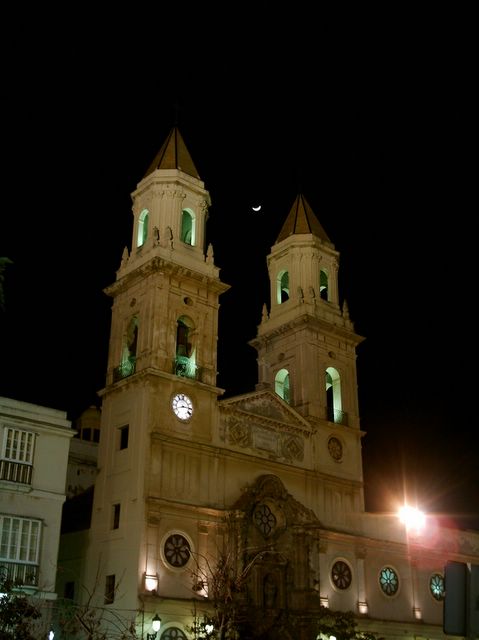
Well, here I am. It’s my last day in Spain, in Cádiz, and I’ve come down to the beach for one final swim. For one final sunset. For one final farewell.


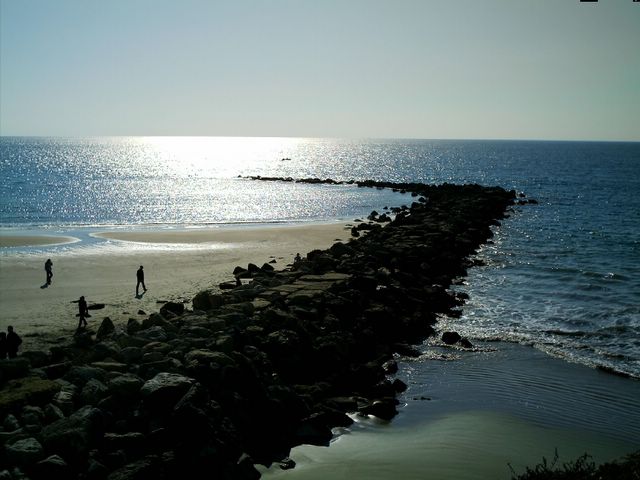
No more stunning views across the Atlantic...

It’s hard to believe how quickly the past few years have flown by. It seems like only yesterday (okay, not exactly yesterday but you know what I mean) when I first decided to come to España. I had come to Iberia to learn Spanish and can still recall the first time I ever set foot on this soil. The only words I knew were amigo, cerveza, and adios. Every time a local spoke it sounded like that rambling crazy guy from back home in Philadelphia that lived down the street in a box. Come to think of it, that rambling crazy guy was named Rodrigo so I guess it comes as no surprise that the Spaniards’ tongue reminded me of my fellow Philadelphian’s heated hour-long debates with the street corner fire hydrant. My quest to learn español led me from Barcelona to a brief six-month stint in Madrid to my final Spanish home away from home, Cádiz. And here I am, on the beach, nearly three years later, able to understand the conversations going on around me and vulgarly dotted with pichas and chochos. I’ve come a long way in this short time: I can hold my own with Spaniards in the café, watch a film on TV and understand the plot’s complicated intricacies (except for Jennifer Aniston flicks because, let’s face it, the plot in that Hollywood trash is usually as complicated as teaching a bear how to shit), and even listen to the neverending speeches of famous revolutionaries named Fidel. I’m confident that, when I eventually do return back to Philly, I’ll be able to join in the passionate conversations going on between Rodrigo and the fire hydrant. Who knows? If I play my cards right, I might even be able to teach the both of them a thing or two about thought-provoking European cinema.


No more sitting in the shade and watching the tide roll out...

But a firm command of español isn’t the only thing that Cádiz has given me. It has titillated my palate and shown me mouthwatering treats I would have never thought imaginable. Washing down cured ham, olives, and perfectly aged cheese with a bottle of wine – all shared between friends while seated outdoors in a plaza under the starry skies. Buying a bag full of freshly fried fish and squid as my fiancée and I strolled along the seaside slowly nibbling away. A warm plate of paella. A fresh pile of prawns. A cool glass of sangría...


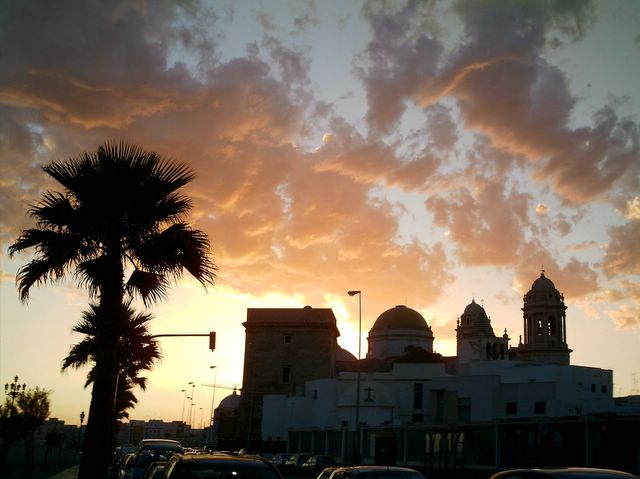
No more sunsets that herald the cool evening breeze...

You have also, dear city, given me friends I will never forget. Some we met during Carnaval and, just as the drunken haze caused by those countless bottles of fortified wine consumed in the piss-soaked streets made way for the next day’s hangover, those friends were forgotten as quickly as they were made. Others have remained in touch and meaningful friendships have emerged that, I’m confident, will only grow as my fiancée and I say goodbye to Spain. Sadly, there’s one friend I’m leaving behind for good. A four-legged companion that I thought I would never love. Alas, she penetrated my heart just as her powerful bowel movements on the sidewalk penetrated the salty-sweet smell of a cool Atlantic breeze. But Ema will always have a place in my memories and I’ll never be able to think of Cádiz without thinking of that adorable, blind Labrador that passed away when we least expected her to.


No more sipping wine on the beach amongst boats and palms...

As I sit here on the beach staring at the boats bobbing up and down in the sea before me, possibly for the last time, I also can’t help but think of the countless adventures I’ve had here and the numerous places I’ve visited. My crazy German neighbor, a collapsed ceiling, Córdoba’s morbid Inquisition Gardens, and the treacherous stench of Moroccan lavatories will all linger on in my memory – probably for a longer time than I would care to keep them there. But at least I’ll have a helluva lot of great stories to regale the little ones with when I’m an old and wrinkled pervert telling them all to lend an ear, gather round, and pour dear ol’ GranPa Philo another double scotch on the rocks.


No more freshly caught fish eaten outdoors in centuries-old plazas...

And what about the kids I’ve taught here in Cádiz? Those spoiled little Spanish brats can kiss my ass and go to hell. I hope I never see them again and glad beyond words to be going back to a civilized country where children know how to behave in the classroom and have some respect. ’Nuff said... Ah, the memories.


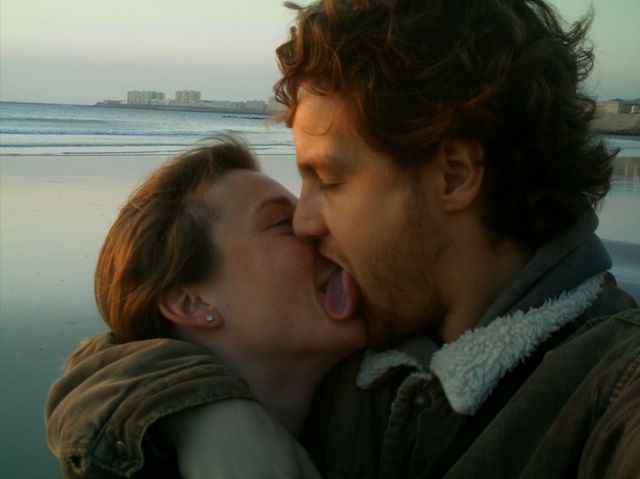
No more romantic walks on the beach interspersed with passionate moments...

And so, our little journey here in España has finally come to its end. I suppose it’s time for one last dip in the Atlantic before the sun does its little dance over the horizon. I’ll have to make sure, though, as I emerge from those seemingly endless blue waters and look over my shoulder to catch the majestic pink hues being painted in the sky, that I don’t lose sight of the footprints I’ve made in the wet sand at the beach’s edge. For when I notice them, I’ll probably just stand there – staring – as the waves gently crash and the approaching tide inevitably erases away all my tracks from the face of this city. From that moment on, Cádiz will indeed become but a memory... one that I will carry with me and cherish no matter where I may be.

7/08/2006

That's A Load Of Bull [JUNE 18, 2006]

The sweltering sun is beating down on the bloodstained dust as their eyes meet. Man and beast, standing there, nervous as to who will make the first move, while the crowds in the bullring bleachers – which eerily resemble those of the Roman Colosseum – cheer on the blood sport with a morbid enthusiasm not seen since ancient gladiatorial matches. The matador soon decides to break the deadlock as he waves a crimson red cape in front of the tired eyes of the enraged black bull and draws in their focus. The beast, a species known as el toro bravo (the courageous bull) and specifically bred for its ferocity in the arena, lowers its lethally sharpened horns and prepares to charge. The matador, whose name comes from the Spanish verb matar (to kill), arches his back and waves the cape once again, unwilling to allow the bull to succumb to the pain of the steel blades lodged into his spine and the numerous cuts and slashes that he has received over the past fifteen minutes. El toro bravo rubs his front-right ebony hoof against the ground, aims for the fluttering red cloth – which he has been conditioned to attack since calfhood – and takes off with the force of a locomotive. The streams of blood pouring down his torso and head, not to mention the excruciating pain, are temporarily forgotten. The only thing that matters now is the assault. Fight or flight at its most basic, except that flight isn’t an option. Just as the beast is about to strike his tormentor and end this torturous nightmare, the matador twirls about on the edge of his toes and effortlessly avoids el toro bravo’s lethal charge. The crowd goes wild as they salute the matador’s grace and poise in the face of death. He acknowledges them with a smug tilt of the head and turns to see where his foe has gone. The bull, confused by the whistles, cheers, and applause coming from the bleachers, soon realizes that he must have missed his target. The searing pain of those raw, open wounds makes the creature want to simply lie down there in the middle of the scorching arena and die. Ironically, the streams of blood trickling down his side are not only draining the beast of life but also serving to cool him in this unbearable heat. If only he could lie down in the dust and rest… slowly drift off to death as the ground sops up whatever blood his body might have left. But the matador won’t hear of it. He’s paid a hefty sum for this prize bull and is insatiably eager to hear more praise from the audience. He urges el toro bravo on and the docile brute, a slave to his instincts and conditioning, takes the bait as he prepares for another futile charge. He’ll have to wait at least a quarter of an hour to end this misery – until the matador has finally had his fill of applause and decides to plunge his sword into the beast with that skilled final deathblow. But a matador’s deathblow never actually kills a bull. It’s up to the assistants to lure the beast into a corner as he chokes up pints of blood and jab the creature two or three times in the neck with a dagger. Only then does the toro's nightmare end. Meanwhile, at the other end of the bullring, the judges are tallying up their scores as the matador takes his proud victory stride around the arena, accepting flowers from his countless cheering admirers. Success. Another Spanish bullfight has come to an end.
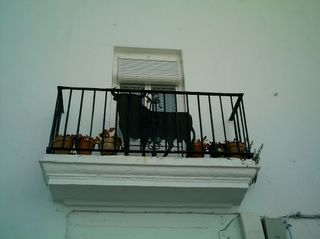

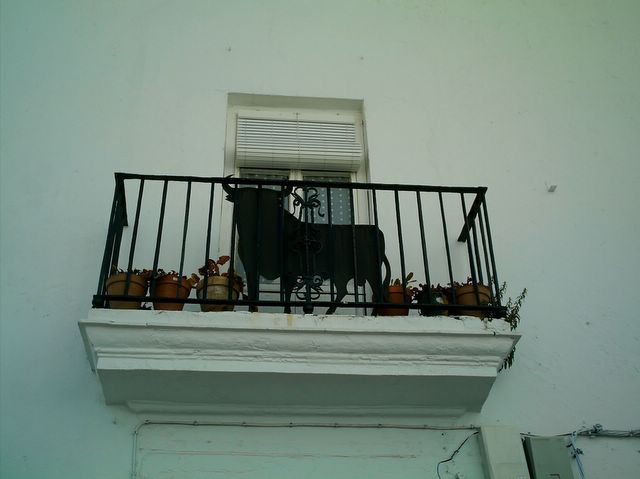
Dude! There's a bull on your balcony! I've got a BBQ grill on mine...

I went to my first bullfight within a week of moving to Spain. I had convinced myself, along with a little help from numerous guidebooks, Hemingway, and one vivid Cosmo article I can still recall (I swear it wasn’t my Cosmo – It was just sitting there on the dentist lobby coffee table. Honest!), that bullfighting was as much part of the Spanish national identity as inexpensive, quality booze and those green olives stuffed with the slimy red thing. Seeing as I had already gotten drunk my first night in Madrid and even found those tasty little olives at the bottom of some cocktail glasses, it was time to search out a toro. And so I came upon Madrid's Las Ventas bullring, the most famous building of its type in the world, and eagerly bought the closest ticket to the arena that I could afford. Search as I might, they didn't sell any popcorn or foot-long hot dogs once past the ticket window, so I sat down in the bleachers empty handed.
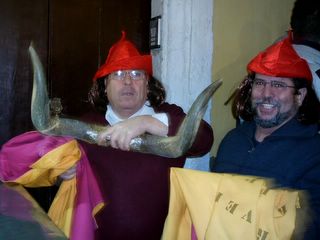

Everyone loves a good bullfight here in Spain,
even the drunkards wandering the streets and wearing crazy hats

What followed was the most gruesome, bloodthirsty and barbarous act that I have ever witnessed being committed in the name of sport. Thank God I hadn’t found any food before settling into my seat because, if I had, I doubt that I would have been able to keep that foot-longer down (Get your mind out of the gutter, you perverts). First off, an angry and confused bull ran into the arena. He had no idea what was going on and I could already see some blood on his sable coat which must have been the result of what is done to the beast backstage in order to enrage even the most timid of toros. Then a man bearing a lance and seated on a padded horse entered the arena and cornered the bull. The mounted man, known as a picador, proceeded to plunge his lance a number of times into the spine of the beast. I was seated close enough to see the bits of flesh and specks of blood which flew into the air each time the sharp blade pierced the raging bull’s hide – and I’m not talking about Robert DeNiro’s ass. After he had inflicted his share of the damage, the picador left the arena, proudly waving his hat to the audience. Next came a group of three banderilleros who each held a pair of ornate knives known as banderillas. One by one, the banderilleros would run up to the toro and lodge their banderillas into the creature’s spine. More bits of blood and gore went flying to the left and right. Finally, with the hope of putting the pitifully weakened bull out of its misery, the matador made his grand entrance onto the arena’s yellowish dirt. He glided elegantly to the center of the arena with his characteristically red cape... It would be another fifteen minutes before I saw the pathetic blood-drenched carcass of what was once a proud toro bravo lying there motionlessly before me. I couldn’t believe the amount of cruelty and inhumanity I had just witnessed and left with the stench of blood drying in the sweltering sun still fresh in my nostrils.
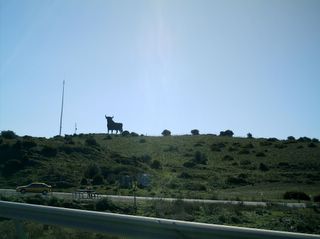

You won't see any Golden Arches or cigarette ads on Spain's highways...
Only Bull

I was shocked, awed, overwhelmed by what I had just witnessed. Was that barbarity in the name of art the same thing Hemingway had romanticized and Cosmo had raved about? If so, I never wanted to see it again – well, maybe once more. I returned to Madrid's Las Ventas bullring about a month later. Call me a heartless tyrant, call me an immoral hypocrite, call me a bloodthirsty sadist, call me Ishmael... But whichever name you choose to call me or how you judge me, know that I am human. I have a curiosity that is built into my psyche – it's helped my ancestors discover fire, create the wheel, and invent multi-angle DVD pornography – and it's that curiosity that drove me to the bullring a second, and ultimately last, time. One of the most well known matadors in Spain was going on stage that day and I had to see if his performance was as brutal as the first one I witnessed. Perhaps it had all just been some murderous amateur's fluke. Well, a fluke it was not. That day's events were even more barbaric than the first's. I swore off bullfights from that day in 2004 onwards and, since then, have stood by my decision happily. Hemmingway, Cosmo, and those tour books, I'm convinced, had it all wrong.
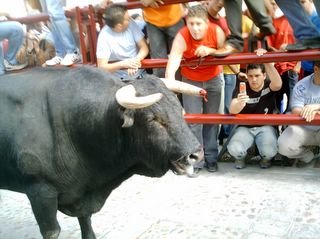

Hey Ernie, does this really look romantic to you?

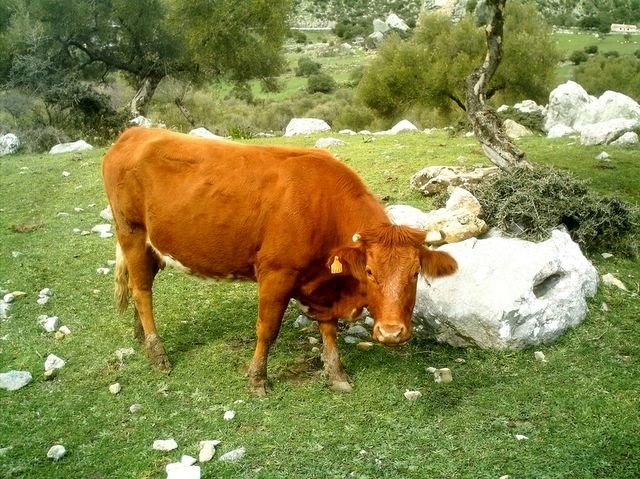
The next time I saw a live bull was during a pleasant walk in the countryside a year or so later. He was grazing and stopped to take a shit. I took a picture and continued on my way.



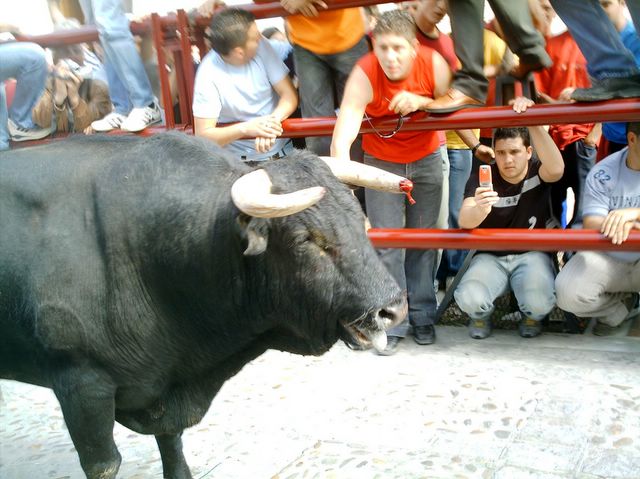
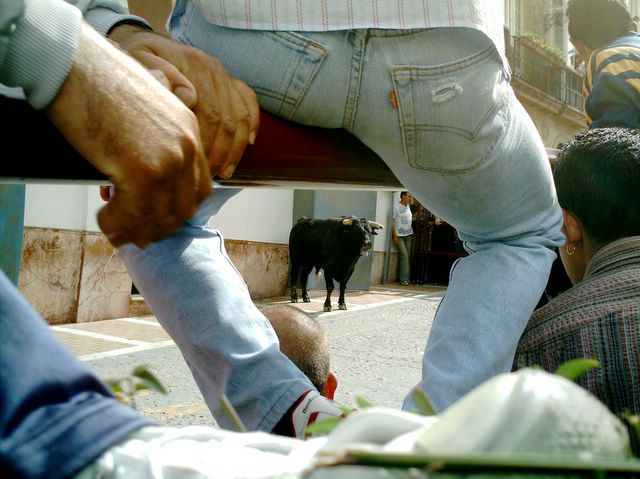
The time after that, the last time in fact, that I saw a toro bravo was at a small running of the bulls. It was so small that it was actually a running of the bull. That's right, just one. It took place on Easter Sunday in a town called Arcos de la Frontera and located about a one hour drive north of Cádiz. My lovely fiancée and I had gone with a friend of mine who was visiting from the States. Guidebooks and Hemmingway had also promised him feats of untold bravery in the face of impending danger. Cádiz, however, does not have a bullring (the last one was torn down in the 1960s to make room for housing) so the unique one-day event in Arcos would have to do.
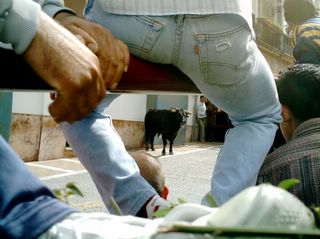

Ah, the local village's running of the bull...
Except that there doesn't seem to be much running going on

Now normally, the running of the bulls takes place in early summer. A bunch of bulls are herded off a truck at one end of town and plow through the streets until they reach the local bullring where they wait over the next few days for a matador to have his way with them. The most famous of these events takes place in Pamplona, a town in the north of Spain, and now draws in thousands of drunken tourists and Spaniards alike willing to pit their beer-muscles against the charging might and horns of a dozen or so hysterical beasts. (Newsweek recently quoted Julio Bernavides Alvaran, a Valencia resident, who was visiting Pamplona to participate in the famous festival, "Life disappears, and you feel your blood moving in your veins. Either that, or it's all the whisky.") Needless to say, there are dozens of injuries and even a number of deaths recorded each year.


"Charge the defibrillator and hook up the IV drip! Oh no, we're losing him...
There's no time for the Coke. Give me two CCs of whisky, STAT!"

In the mountains of Cádiz Province, though, we have no Pamplona. What we have is Arcos and its traditional running of the Toro del Aleluya (literally, the Hallelujah Bull) each and every Easter. The local vendors proudly sell tacky t-shirts with "Toro del Aleluya" printed on them and banners wave gloriously off balconies. As noon strikes, the Hallelujah Bull is released from its cage after a few jabs and sword slashes and charges through the streets of Arcos in pursuit of those stupid or drunk enough to cross the protective barriers erected by the town council the night before. Now, whereas the beast's warpath would normally end at the local bullring, the problem with Arcos de la Frontera is that it doesn't really have one... So they just sort of let the bull wander around town for an hour or two. When the Hallelujah Bull starts getting tired, or rather, when the locals get tired of looking at it just stand there and prodding it on, they rope up the bleeding, exhausted brute and drag him along the cobblestone street back to his cramped cage. A perfect way to celebrate the resurrection of our Lord and Savior Jesus Christ. Hallelujah. Amen.
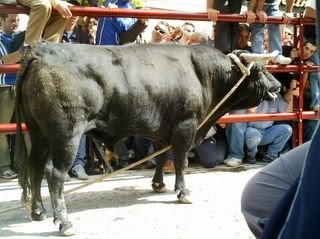

Don't Christians just do the darndest things?

In the end, I may find this whole fixation of torturing toros barbaric, but I acknowledge that I am a foreigner. I’m not Spanish and it’s not part of my culture. So who am I to judge? Besides, most Spanish people I know find the American system of not providing at least basic free healthcare to all of its citizens while, at the same time, spending billions abroad to protect business interests far more barbaric and inhumane than killing a few bulls could ever be. Who am I to decide whether bullfighting is morally reprehensible or not? All I can do is express my opinion and say I don’t like it. No sir… I don’t like peanut butter and jelly sandwiches, I don’t like Roger Moore as James Bond, and I don’t like bullfighting.

I feel that Spaniards, however, do have a right to criticize bullfighting. It is their nation and their duty to condemn something as barbaric and uncivilized, not ours as foreigners (unless, of course, human rights violations are involved). In this respect, trust me, condemn it they have. One thing Hemingway, Cosmo and all those other romanticized notions of the bullring neglect to mention is just how disgusted many Spaniards are by the “art” of bullfighting. They call it brutal, bloodthirsty, barbarous – well, basically all the adjectives I’ve used to describe it. Anti-bullfighting organizations can be found in every city and major town of España. As far as their growing numbers are concerned, the Shame of Our Nation – as these protesters have dubbed the toro’s trials and tribulations – has no place in their homeland. It should be banished to the age of the Roman Empire and the gladiatorial matches from whence it came.
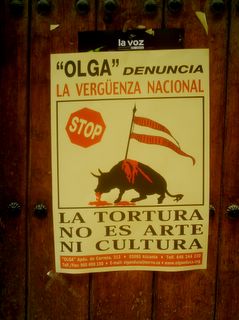

translation of a poster found in Cádiz:
"OLGA denounces The National Shame: Torture is neither art nor culture"


So, where does all of this leave the future of Spain’s national pastime? Well, with one third of the country cheering on the matador, another third boozing it up so that they can get enough courage to race in front of toros, and the final third disgusted by the entire spectacle altogether, the nation is as divided as ever. But as long as the sable toro bravo remains a symbol of national identity and ingrained in the cultural heritage of the populace, it looks like the status quo won’t be changing anytime soon. Meanwhile, that very symbol will continue to be slowly and gruesomely slashed, stabbed, tortured and mutilated in front of thousands of cheering spectators as stocks are dependably replenished and conditioned for next year’s fighting season. After all, the entire sport, art, or whatever you may call it runs on one thing and one thing alone… a huge load of bull.

6/12/2006

E Pluribus Unum... To Go, Please [June 11, 2006]

Earlier this week over lunch...
"Hey, baby. You wanna hear a joke?"
"Not really. Especially if it’s one of your jokes but I guess I don’t really have a choice, now do I?"
"Nope. OK, so here it goes. Did you hear about the Polack who returned his bagel?"
"No."
"Yeah, well it turns out there was a hole in it!" I pause and wait for laughter – even a polite smile because I know my jokes are pathetically horrible.
But I get nothing in reply, "And?"
"And... Well, that’s it. Get it? A bagel? It’s supposed to have a hole in it."
"What’s a bagel?"
"You know, the breakfast food. The thing you eat with cream cheese. A bagel."
"Cream cheese? Do you mean that Philadelphia Cream Cheese stuff they sell at the supermarket?"
"Yeah."
My lovely Czech fiancée looks confused as she finishes slurping up a mouthful of spaghetti in white wine mushroom sauce and eventually washes it down with a sip of water. "Breakfast food with that Philadelphia Cream Cheese stuff... What do you mean? Something like a bread roll or toast?"
"No, no. A bagel. It’s like bread but round and hand-size. And it’s got a hole in the middle."
"A donut? Why would you eat cream cheese with a donut? That’s just disgusting."
"It’s not a donut. It’s made out of dough around this size," as I touch my index fingers and thumbs together to form a circle, "and it’s got a hole in the middle of it."
"Sounds like a donut to me," as she twirls up another forkful of spaghetti.
"It’s not a donut, for God’s sake. I think it’s originally Yiddish food or something Central European."
"Well, I’m Czech and you can’t be any more in the center of Europe than the Czech Republic. Trust me, I’ve never seen or heard of this bagel thing here, there, or anywhere in Europe."
"Hmm, I don’t know," as I twiddle the spaghetti in my plate around. "I guess it was a stupid joke anyway..."
"And why," my Czech asks after swallowing another mouthful, "would a Polish person make that kind of a mistake? If there are supposed to be holes in these ‘bagels’ of yours, wouldn’t he have known it beforehand? Why return it?"
"You know. Because he’s Polish!"
"So?"
"Come on... The stereotype that Poles are supposed to be, well, a little slow in the head."
"What do you mean? Like, stupid? Why would that be a stereotype about Poland?"
"I don’t know. It just is. At least, back home in America it is."
"Well I’ll tell you what’s stupid. Americans are stupid for having such an idiotic stereotype. I’ve met plenty of Poles and none of them were – How did you put it? – a little slow in the head. And what about Copernicus and Marie Curie? They were both Polish. Do Americans consider them to have been ‘slow in the head’ too?"
"Well, no. I guess not... You know what? Just forget I ever even mentioned the whole stupid joke to begin with," as the conversation comes to an abrupt end and we finish lunch in silence. It’s times like these I wish I were back home in the good ol’ U.S. of A.


The shelves are loaded with Philly Cream Cheese over here, but what about the bagels?

The life of an expat (that’s short for expatriate for all you who have never read a Hemingway novel) is not an easy one. S/He is mocked for making assumptions that seem normal enough back home and ends up passing each waking hour in a futile search for that elusive childhood-favorite snack food. My Achilles’ Heel is Reese’s Peanut Butter Cups and I’ve spent the last five years on the lookout for those delicious little bastards but, alas, they’re as hard to come by in Europe as a bidet is in North America. And just as my imaginary Frenchie expat-brother in Minneapolis yearns to feel a high-powered jet of water tinkle his nether regions after a massive bowel movement, I too yearn to sink my teeth into a milk chocolate cup filled with creamy peanut butter... But some things are just not meant to be. Pierre will have to get used to double-ply toilet paper and I’ll have to make do with nougat-filled Swiss chocolate.

However, I along with my American expat brothers and sisters around the globe shouldn’t really complain about our situation. After all, we’re experiencing foreign cultures, broadening our cultural horizons, and wandering down that adventurous road less traveled – All while handling as little discomfort as possible. You see, as Americans, or rather I should say North Americans because Canadians are also included in this group, we have fewer hurdles to jump in a foreign land than any other expat nationality. First of all, and most importantly, we speak English and by far the most studied language the world over is – you guessed it – English. Whether a North American expat chooses to make his or her home in Timbuktu or Seoul, a local who has mastered the art of our spoken tongue is never far off. No matter how much a native French or Spanish speaker would like to make the same claim about their native tongue, it simply isn’t the case... Parents from Finland to Taiwan don’t send their kids off to learn French if they haven’t already conquered the world’s only true lingua franca, English. Now I know what all you Brits, Irish, Aussies, and Kiwis are thinking: "GC, you arrogant Yankee wanker, we speak the same bloody language!" That may be true, but unlike Americans and Canadians, you guys can’t drive on 80% of the world’s roads without confusing your left with your right. Even Winston Churchill was knocked down by a taxi-cab when visiting New York City because he glanced the wrong way before crossing. So trust me, when taxi-cabs are knocking you down because you don’t know where to look, being able to speak English doesn’t quite seem like such an advantage anymore.


"Is nice trash here. You like? I give you good price!"
(No kidding. I once spent a good fifteen minutes talking to this homeless guy in English!)

Language comprehension and road compatibility aside, there’s another reason why I assume that I don’t feel as isolated in a foreign land as most of my non-North American expat brethren. Like it or not, ever since the 1950s our cultural products have imperialistically spread throughout the world. American music, franchises, food and beverages have made their way across six continents and are set to stay. No matter what country you’re in, one can always get a bag of Doritos, wash it down with a 7 Up, and sit back to enjoy an episode of The Simpsons. Sure, you can’t always find bagels, but the very fact that every supermarket in Cádiz stocks three different flavors of Philadelphia Cream Cheese proves my point. American culture and products have conquered the world in more ways than just Coca-Cola, blue jeans, and McDonald’s. It’s on every other TV channel, every other radio station, and in everyone’s fridge. What does that mean for North American expats? Whenever you miss home, there’s always a flavor of it just around the corner – as long as you’re not looking for bagels and peanut butter cups.


Cheetos, Doritos, Pringles, oh my... Any American couch-potato's dream come true

In fact, this worldwide success of American products can be accurately judged by a single factor – the staggering amount of cheap imitation rip-offs. Every industrious entrepreneur from the four corners of the globe tries to profit in one way or another from the popularity coattails of American products. Here are just three of my personal experiences to back the claim up:

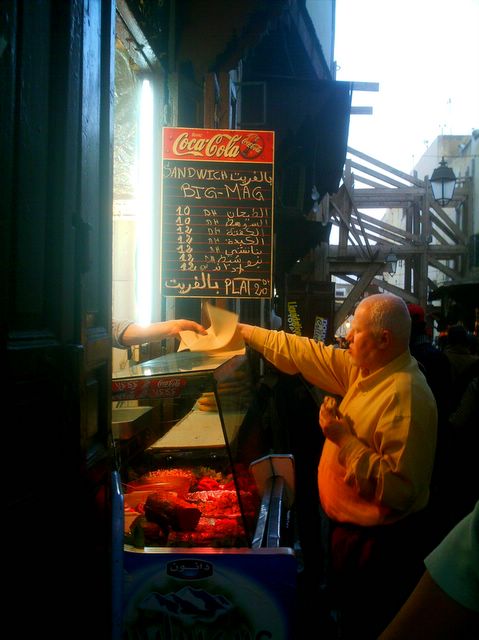
While wandering through the crowded food markets of a busy medieval Moroccan city this past April, I spotted a street vendor selling some snack food. He was huddled between two butchers’ stalls both covered with flies and the stench of death. What ready-made wonder was this poor Moroccan cook peddling to his hungry Arab clients? A tasty concoction he had dubbed the Big Mag.


"Praise Allah! I shall have one of your delicious Big Mags!
(I never did like your competitor's Whoopers.)"

Another McDonald’s related rip-off is from a little bit closer to home. There’s a fast food joint here in Cádiz that sells burgers and fries for a fraction of the Golden Arches cost. It’s also got quite a witty name, which is where it rips off the American original, but before you can understand it, a little explanation is in order. McDonald’s is often mis-spelled by the locals as MacDonald due to their accent. Furthermore, the letter C in Spanish can either be pronounced as a K or as an S. Therefore, Mac, as in MacDonald, is normally pronounced MAK but also sometimes jokingly as MAS. Confused yet? Hope not cause here’s where the word play gets tricky. Más actually means "more" in Spanish. The word for "less" is menos. So, what’s the name of this ever-popular Cádiz fast food eatery? MenocDonald.


Why pay MoreDonald's for your burguers when you can pay Less?

Although the Spanish love donuts and sell them at every corner shop and bakery, I have never encountered a store in this country dedicated exclusively to the sale of, as my fiancée would put it, the bagel’s sweet twin – That is, until I went to Córdoba. As I visited that grand Spanish city earlier this year and explored its countless cobblestone roads, I spotted a few of the locals carrying what seemed to be a Dunkin’ Donuts bag filled with a half dozen of those tasty treats I remembered from back home. I should say that, throughout my two and a half years here in Spain, I have never seen a Dunkin’ Donuts franchise. I’ve seen them in Prague, Athens, and London – so I know they exist in Europe – but never in Spain. Not even in Madrid or Barcelona. Imagine my surprise, then, when I finally rounded that corner in Córdoba and spotted it in the distance. I couldn’t wait to sink my teeth into a Boston Kreme or a Cruller as I made my way through the entrance. I stepped up to the counter, which looked exactly like the countless Dunkin’ Donuts counters I’ve visited over the years, and prepared to order from an employee who was wearing that same ol’ Dunkin’ Donuts uniform. Then it hit me... The place wasn’t actually a Dunkin’ Donuts shop. Everything looked like the franchise, from the store’s name to the colors to the donut rack behind the counter, but it wasn’t Dunkin’ Donuts. This place was called Duffin Dagels. A little taken aback but not discouraged, I chose to ignore the blatant copyright/trademark violation and ordered myself what had been dubbed as a "Dagel with Creme". I don’t know how Duffin Dagels does it, but that delicious little treat tasted just like a Boston Kreme from my youth. I greedily scarfed it down and went back for seconds.


Duffin Dagels, You've done it again!
What's the secret trademark recipe behind your delicious Boston Kre... I mean "Dagel with Creme"?

I’ve encountered many more blatant rip-offs throughout my travels abroad – far too many to mention here – but, as I previously said, it all mainly comes down to being an indisputable sign of just how omni-present American products are. When Muslim street vendors privately curse the Great Satan’s foreign policy yet publicly sell Big Mags to eager consumers in the heart of an Islamic city, there’s something to be said about our cultural influence around the globe. Like it or not, it’s here to stay.


Always Coca-Cola – whether there's a jihad going on or not

So, in conclusion, what does all of this mean? Well, for all of you North American expats out there, stop bitching and moaning about how strange other cultures are and how difficult you’re finding it to adapt. Compared to Japanese, Ukranian, or Italian expats, you’ve got it easy. You can speak your native tongue anywhere in the world, drive on the right with ease, and get yourself a Duffin Dagel in Spain that tastes just like the ones back home. As for all of you still stuck in the U.S.A. or Canada, scared to see the world through a non-package holiday or frightened to go live that adventurous year abroad in some strange country... Trust me, it’s not that strange. You’ll be able to communicate with ease and still buy those potato chips you love from back home, all while enjoying the wondrous experience of immersing yourself in a new land and culture. Just make sure you get your fill of bagels and Reese’s Peanut Butter Cup before you step onto that plane because some things, no matter how popular America’s products may be, have yet to make it across the Atlantic. Oh, and leave the Polish jokes back home too. You’ll have more success getting laughs from the locals by making farting sounds with your armpits.

5/22/2006

My Confession [MAY 21, 2006]

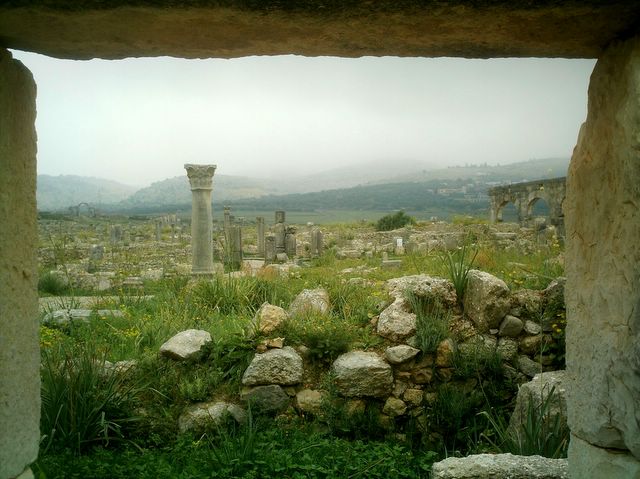
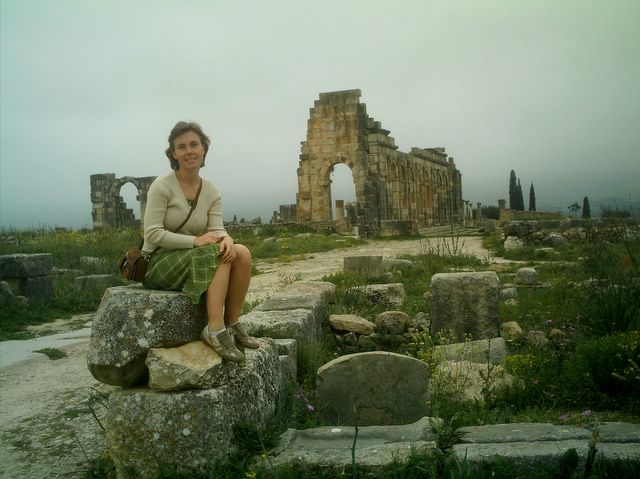
The way those large, erect cylinders draw my gaze from afar. The way they gleam in the sweaty, hot sun. The way that smooth surface, the closer you get, reveals itself to be marked with the slight imperfections inevitably associated with the passage of time... Hello, everyone. My name is GC Philo and I’m hear to admit that I have a problem. I’m a "Roman ruins" junkie.


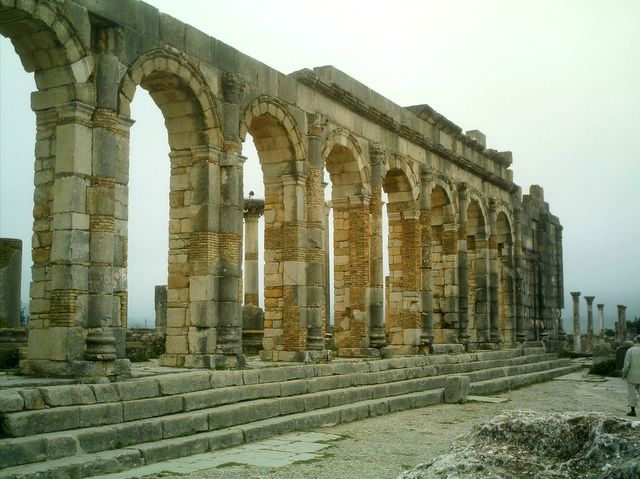
Oh yeah, baby. Let me see those columns. You KNOW how I like it!

It all probably started back in my early teenage years, that time of constant change and self-reflection when we all try to discover who we really are. My parents flew the whole family over to Greece one summer and took us around those famed centers of Hellenic Antiquity – Athens, Corinth, Olympia and even Delphi. As we wandered the scattered stones and rubble occasionally interspersed with a pristinely preserved mosaic or engraving, I felt my imagination run wild. I was no longer in an age of video games and blue jeans, but one of Olympic olive wreaths and togas. I could see how those people – the most civilized Europe would witness until the High Renaissance some 1500 years later – lived and worked. I also saw how cruel history could be. It had the power to change a once mighty civilization, one that had dominated the known world for centuries, into a heap of marble that now only commands the attention of Japanese tourists’ cameras.


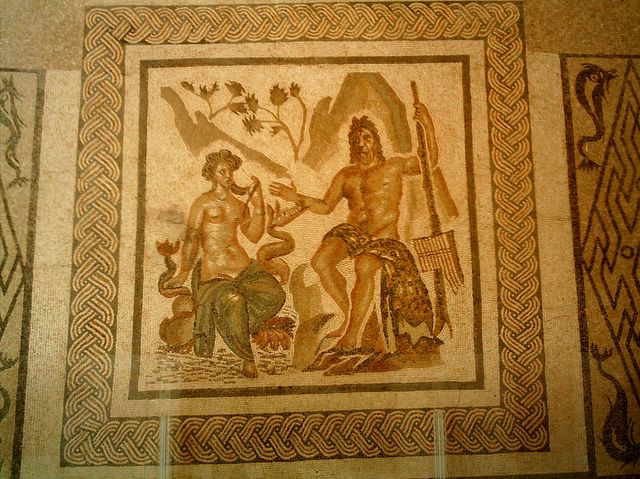
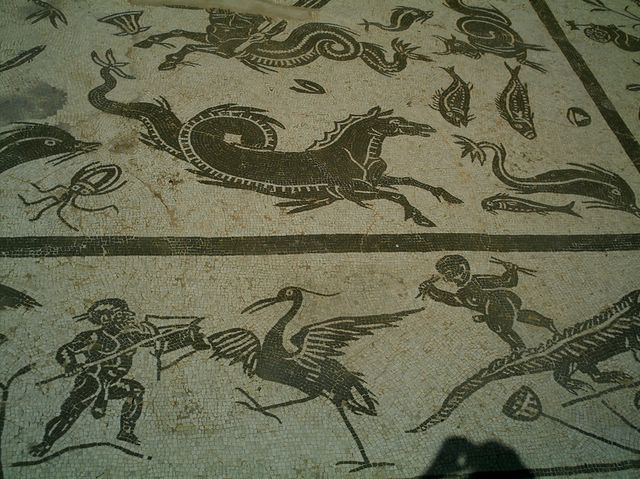
Lovely, lovely mosaics... Especially the ones that show little midgets with huge penises shooting storks.
You complete me - You had me at Hello.

Somehow, though, the Romans always interested me more than the Greeks. I mean, even though the Greeks started it all, the Romans did it more grandly, more enduringly, and more erotically. This healthy interest in Roman orgies, in fact, eventually developed into my Bachelors Degree in History. Okay, okay – I won’t lie to you. It’s even one of the main reasons why I moved to Europe in the first place. If this is going to be a true confession, I need to let it all out... I had to get my "Roman ruins" fix somehow and when the oldest thing you can find back home is a crappy Indian arrowhead from 1600, Philadelphia just doesn’t cut it anymore. Here in Spain, I’ve got enough smack to hold me over for a lifetime.


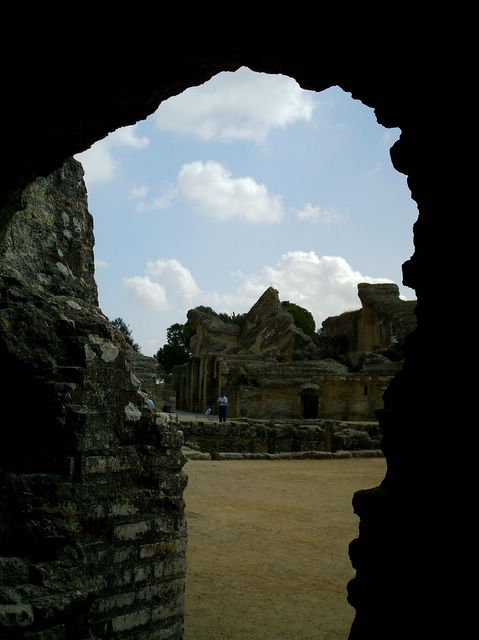
You can't find something like this back home in America.
Then again, I've never been to California.

I try to visit every Roman, or the rarer Greek and Phoenician, ruin no matter where I am and usually spend hours wandering through what was once the heart of these great towns. But, like I said, I’m a junkie and junkies don’t just look at the sights and snap a photo or two. No, they always go overboard in their strange and delusional ways and I’m no exception in the way that.... (I knew these "Roman ruins" Anonymous confessions were going to be tough, but not this tough.) I guess it’s time to come completely clean. You see, I actually adopt a Latin name for myself and those who are traveling with me each and every time I set foot on an archaeological site. Worse yet, throughout our visit, I only refer to the others in my party with these names. I know, I know... I need help. That’s why I’m here.


Sometimes I just hide in the shadows of Roman ruins and stare at tourists.
I call that my "special" time.

My Latin name is Testicles (emphasis on the last syllable just like in "Japanese"). My fiancée has grudgingly come to accept hers, Breasticlina, as well. But these are by no means the limits of what is indeed the sick and twisted reality within my head. I have wandered through Roman ruins in Morocco with Forgetfulcus. I have scaled the interior of the Colosseum with my ex-girlfriend Alcoholica Maxima only to see her change into Cunnilinga as we walked through the Pompeii city gates later on that very same week. I have witnessed the power of my old room-mate Flatullus Extremis as he expelled those famed noxious fumes within the very walls of the Athenian Acropolis itself. Even my own brother, Testicles Major, made a brief appearance in Cologne, Germany when I least expected to see him... Not to mention my father, Baldicus Maximus, and my friend from high school, Fat Fuckicus (who coincidentally happens to be a bit overweight), when they both decided to visit us here in Spain last spring.


"I assure you, Baldicus Maximus. There's no way THIS citizen
is casting his vote for Fat Fuckicus as next Roman Pro-Consul!"

However that, dearest support group, is not the extent of my dilemma. If only it were! You see, I also feel the need to speak in an antiquated fashion each and every time I visit these archaeological sites. I can almost remember the first time my lovely finacée and I stepped foot in a Roman theater together:
"What ho, Breasticlina?"
"What?"
"‘What ho?’ I say!"
"Are you calling me a ho?"
"Surely you jest. ’Tis I, Testicles. Forsooth, your heaving bosom knows no bounds. ’Tis no mere coincidence that your moniker bears witness to such a claim!"
"What the hell are you talking about?"
"Tut, tut. How you amuse me so! Such unfound modesty from a goddess whose brassiere can but barely contain the awesome fury within. Aphrodite herself shudders with envy!"
It kept going on like that for about ten minutes until she eventually started to ignore my crazed ramblings. Afterwards, once we stepped foot past the exit gate, I explained to her what had happened and only then did she fully understand.


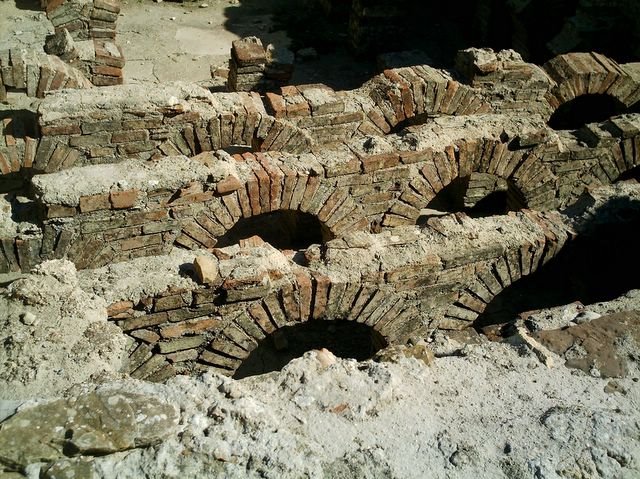
So you already knew the Romans could build temples to last, but did you also know they had underground heating?

Breasticlina, though, has since learned to live with my illness. She humors me now every time we walk under an aqueduct or through a temple, and sometimes even cracks a joke. But I know that, under that smile, she’s actually crying. It is for her that I need to break this addiction and for her that I’m giving you this confession. I need to nurture the GC Philo she once fell in love with... not the Testicles I have grown to become.


"Very funny and imaginative, dear. Calling me Breasticlina because I have large breasts.
But why are we calling you Testicles, then? Those midgets in the mosaics had a bigger package!"

Breaking this bad habit, though, isn’t going to be easy here in Spain. The land of Hispania, as most of modern day Spain and Portugal were known to the Latins, contained some of the most peaceful and prosperous provinces in the entire Roman Empire. For this reason, Spain (along with Italy) is home to some of the best preserved two thousand year old sites the Western World has to offer. In the south of Spain alone, there are the extensive ruins of Italica (a few kilometers outside Seville) which was the birthplace of both Emperor Trajan and Emperor Hadrian and is home to the third largest amphitheater in the Roman Empire with a seating capacity of 25,000. There is also Mérida, once known as the "Rome of Iberia" and current capital of the Spanish region of Extremadura, which was more populated two thousand years ago with over 100,000 Latin-speakers than it is today with a bit under 50,000 Spanish-speakers. In fact my current home, the port of Cádiz, claims to be the oldest city in Europe having been founded by the Phoenicians, who named it Gadir, some three thousand years ago. A couple of the sights in Cádiz include a Roman theater nestled between a few modern apartment buildings and a Roman military wall that runs through the city center and fuses with whichever random building that happens to cross its path. How am I supposed to kick this nasty habit when the ghost of Testicles haunts me from every corner and I know that, no matter where I step, there are countless layers of un-excavated artefacts below my feet?


"Where do you live in Cádiz?"
"Go past the supermarket and, across from the basketball courts, make a left at the Roman theater. You can't miss it!"

That’s why I’ve come here today to this "Roman ruins" Anonymous meeting and decided to give this confession. I know that I need help and I also know that, by letting my addiction be known and admitting it to myself, I’m one step closer to finding a cure. It may not be easy and the journey will most likely be long and arduous, but it’s one that I’m willing to take in order to stop the suffering that I’m putting my loved ones through. They deserve better, especially my lovely Breasticl – I mean, fiancée. Just as importantly, I deserve better than to live life from one fix to another. That’s why I’ve decided to give it all up. Cold turkey. Come July, I’m saying my farewells to this land of unending Latin temptations and dashed orgiastic dreams. The only way to put that final nail in the coffin of Testicles and silence him, once and for all, is to deny the filthy beast the one thing he craves. In two months time, I’m off to ruin-less Prague and leaving this Spanish whore behind... You see, the Romans never made it as far north as the Czech Republic. I hope that it’ll work.

5/14/2006

The Gypsy Blues [MAY 14, 2006]

Friday night. A crowded, smoked filled bar in the working district of a nameless town on the Andalucían coast. (Well, actually, it’s Cádiz but "nameless town on the Andalucían coast" just sounds a lot more travel-romantic, doesn’t it?). The clientele have been ordering their wine by the bottle for the past hour or so while nibbling on such typical Spanish tapas as jamón serrano, queso manchego, and tortilla. The once hushed table chatter has now built up to such a volume that you can’t even make out the strange language being spoken at that single table to the dimly-lit back... the one under that stuffed and mounted bull’s head. The only thing that’s for sure is that they’re the only ones not speaking Spanish in the joint.

"No way. Quantum Leap blew Fantasy Island away. Hands down!"
"Listen, all I’m trying to say is that is was a pretty creative idea. Don’t you think? I mean – An island where your fantasies come true. That is damn creative," my friend responds.
"OK. I’ll give you that much. But Quantum Leap was just as creative if not more. Some of those leaps. Like, like the time he became Marilyn Monroe was..."
"Hold on. I don’t think he ever became Marilyn Monroe. He turned in to someone who knew her. I’m pretty sure it was a chauffeur or something."
"Whatever. That’s besides the point. What I’m trying to say is... Forget it." I turn to my girlfriend, "What do you think, honey? Quantum Leap, right? A much better show, right?"
"I don’t know. What the hell is a quantum lip?" she contorts her puzzled Czech face.
"Oh right, the whole Communism thing. You guys never got those shows in the Eighties. Well, it was about this guy, a scientist actually, Doctor Samuel Beckett, who entered..."
"Enough already," she interrupts. "Will you two shut up? No one cares about your stupid Fantasy Island or Quantum Lip television programmes. Besides, something’s happening on the stage. I think they’re starting."
"Oh, sorry, dear..." I grab my glass of wine, lean back into the wooden chair, and take a sip before mumbling, "Quantum LEAP not Quantum LIP," to no one in particular.

As everyone at our table silently directs their attention to the motley crew of well-dressed Gypsies and slick-haired Spaniards who have now walked on stage, the tables around us continue their idle chitchat. The young guitarist plucks his first strings and the rhythmic clapping coming from the three others standing to his right slowly builds pace. The patrons surrounding us keep up their drone-like conversations, almost completely ignoring the performing musicians. Not many books have been written on Spanish manners – probably because there aren’t any. But that’s besides the point. Eventually, once the guitar and choral clapping reach what seems to be their climax, a heavier-set, middle-aged, Gypsy women to the guitarist’s left rises to her feet and belts out the first verse of a ballad of unfulfilled desire. Everyone in the bar instantly stops what they’re doing and turns their interested heads to the stage. The passion in her voice grabs the attention of the seated masses and doesn’t let go. She soon breaks into an elegant dance – the ripples of her multi-colored dress undulating in its wake – and draws the occasional "¡Olé!" from random, spellbound onlookers. A night of flamenco has begun.


Work it, baby... Work it!

Gypsies get a lot of grief here in the Old World. Their nomadic background and centuries-old reputation as swindlers and con-artists has done little to help the modern European perception of these cultural outsiders. Historians estimate that this ethnic group first migrated onto this continent from the Indian subcontinent during the first half of the last millennium (that’s 1000–1500AD for all of you high school drop-outs or unsuccessful GED candidates). Ever since, they have consistently formed the poorest and least educated sector of society. Gypsy literacy levels throughout the continent hover at an astonishingly low 40–50% which is even more shocking when you take into consideration that, except for Albania at 87%, not one European nation has a literacy level below 98%. This poverty and lack of education, obviously, also leads to a disproportionately higher rate of crime in the Gypsy community. I recently read a study, for example, that stated even though Gypsy women only make up about 1.5% of the Spanish population, they account for over 25% of Spanish prison inmates. Anyway you look at it – from Portugal to Russia or Norway to Moldavia – there’s a lot of work to be done in the Gypsy community.


Baby Bigot-Gomez finally realizes the wrongs of her ways, "Stinkin' Gypsies.
What d'ya ever give Spain?! Oh... right. The whole flamenco thing."

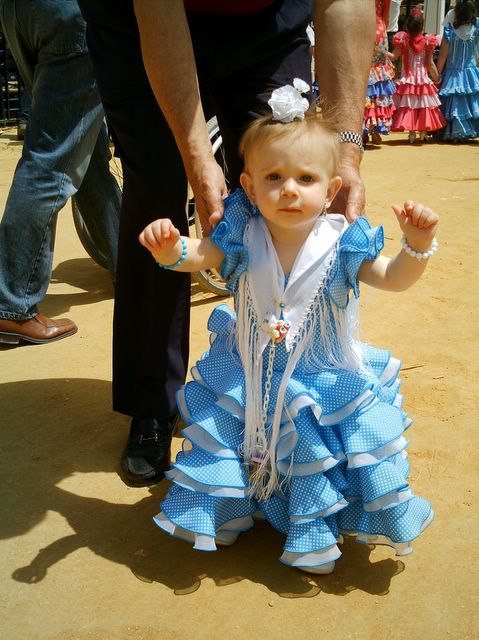
Outside of Central Europe, Spain boasts the largest population of Gypsies and Andalucía, with nearly 60%, is home to most of them. Spanish Gypsies, or gitanos, are no exception to the European norm. They are perceived as being lazy, thieving and government-leeching. They are discriminated against in interviews, schools and the media. They are the one neighbor that no self-respecting Spaniard would ever want to live next to. But despite all of this blatant racism and outright bigotry, no matter how much they are spat on or looked down upon, there’s one reason why a gitano always walks with a head held up high – Flamenco. The gitanos invented Spain’s most renown music and gave it its passionate dance and ostentatious dress. They started it all in their poor ghettos centuries ago – nurtured it, perfected it – and then eventually handed it over to the Spaniards confident that they would never be able to produce a national style of music that could ever rival their own. And the gitanos were right. Today, Spaniards from every walk of life dance, sing, and enjoy the flamenco rhythm. They perform it on stages and in bars throughout the country while blaring it proudly on home stereos. Flamenco encompasses what it means to be Spanish and is España at the very heart of the proud nation’s name... except that it really isn’t. It’s actually gitano and everyone knows it. Ask any Spaniard to tell you who plays the best flamenco in town and they’ll all agree: "Those dirty, filthy, thieving Gypsies down the road. God bless ‘em!"


"Damn. Those gitanos really know how to shake that booty."

My fiancée and I are fortunate to be living in one of the world’s foremost flamenco centers. Cádiz has been a hub of guitar making and innovation for centuries. In fact, some historians claim that the famed Pagés brothers actually invented the first modern guitar here in 1803. And, no, it probably wasn’t a Stratocaster Electric. Spanish guitars (which include most modern acoustic guitars) weren’t originally designed to play Blue Suede Shoes or Smoke On The Water. They were meant to accompany the passionate songs and exquisite dancing of the flamenco elite – of which we have no shortage of here either. The Province of Cádiz has been home to some of flamenco’s greatest performers throughout the ages. Just to mention modern times, the internationally-known Paco de Lucía, considered to be the best living guitarist, was born and raised here as was the greatest flamenco singer to ever walk the earth, El Camarón de la Isla. El Camarón, unfortunately, died in 1992 at the age of 41 after years of an uncontrollable lifestyle and heroin abuse. He was, of course, a dirty, filthy, thieving gitano... but that still didn’t stop the estimated 100,000 people that turned up at his funeral.


Granny Gomez is dancing the flamenco...
And she's lovin' every minute of it!

One of the results of this proud Cádiz tradition of flamenco is that one can see and hear it nearly everywhere. Young kids who just got their driving licences don’t cruise down the beach in dad’s car and ogle bikini-wearing babes while pumping out hip-hop on the factory-installed stereo. No, they do it while pumping out flamenco. When locals go out with friends just to chill out on a park bench, shoot the breeze, and drink a bottle of beer or two, it’s never long before the rhythmic clapping of a flamenco tune takes over. When mothers are trying to lull their babies to sleep, they moan and wail a flamenco song at the top of their lungs into the baby’s ear – well, I haven’t actually witnessed it but I’m sure that happens every now and then. What we have witnessed, though, was a flamenco "Christmas Carol" show this past December. A bunch of gitanos on stage started dancing and singing away about how a baby Gypsy had just been born in a manger in Bethlehem as everyone in the audience clapped away and threw in the occasional "¡Olé!" I had no idea Jesus was a Gypsy... I always thought he was Black.


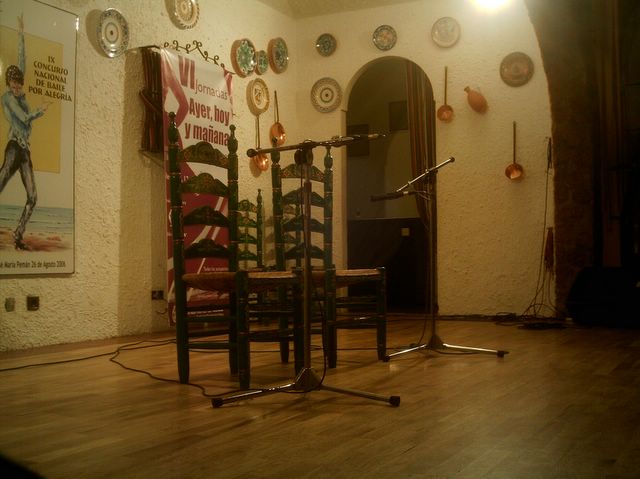
The stage is set for the Gypsy Blues...

So, where does all of this leave me and my lovely fiancée? Well, when we first arrived in Cádiz about two years ago, we were eager to go and sit through as many flamenco shows as we could. By the time Christmas came round, and we found out that Jesus was actually a Gypsy, we were already sort of getting tired of the whole thing. Now, we’re lucky if we go to a flamenco show once every couple of months. The problem is, no matter how creative, lively, and passionate flamenco may be, it’s still something foreign to us. I guess it just either grows on you or it doesn’t and, after spending countless nights in seedy flamenco joints, the entire novelty of the thing has just worn out. At the end of the day, we’re not Spanish and we’re definitely not gitano... we’re just adventurous foreigners with a penchant for traveling. So how could we ever come to love this local art form as fervently as the people of Cádiz? The simple answer is that we can’t. Oh well, I guess we’ll just have to amuse ourselves somehow else. Now that I think of it, someone told me the other day that they’ve already released most of the Quantum Leap seasons onto DVD. Screw flamenco, it’s time I taught my fiancée some of the benefits of not living under Communism in the 1980s – quality television programming. Well, that and the whole freedom of speech thing.